


How to Run Ads on ChatGPT: A Practical Pilot Guide
For the marketing-savvy, it seemed only a matter of time before ads appeared on ChatGPT.
That day is finally here.
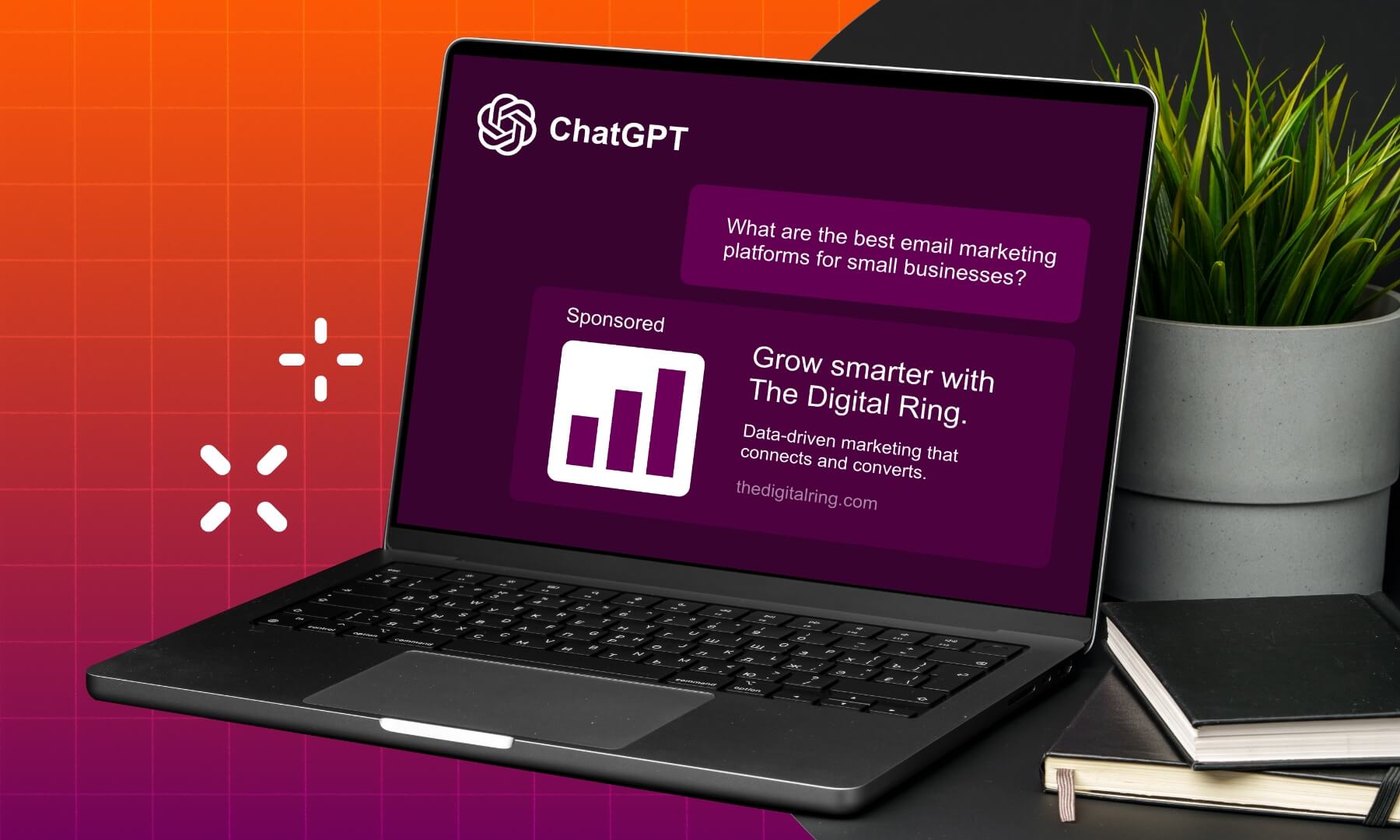
OpenAI has begun rolling out ads for ChatGPT through a limited pilot, gradually expanding advertiser access while introducing new buying options, CPC bidding, and measurement tools. It's still early, but one thing is already clear: This is a fundamentally different environment where people arrive with curiosity, intent, and questions.
That’s important because most advertising platforms are built around interruption or demand capture. ChatGPT lives somewhere in between. People use it to compare products, explore ideas, and work through decisions. That creates a unique opportunity for brands willing to meet customers during one of the most influential stages of the buying journey.
As Nick Perkins, Chief Strategy Officer here at The Digital Ring, puts it:
"This is like being the first batch of companies to run ads on Google Search. As user behavior shifts and more people are using AI to research ideas, products, and services, brands have the opportunity to educate potential customers directly within a platform where attention and curiosity are at all-time highs."
Before you get too excited, that doesn't mean every business should rush to launch a campaign tomorrow.
Like any emerging platform, ChatGPT advertising comes with evolving capabilities, limited inventory, and measurement that's still maturing. If you're wondering how to run ads on ChatGPT, this guide walks through what marketers should know today, how to evaluate whether the platform fits your business, and how to build a thoughtful pilot that produces useful insights instead of expensive assumptions.
Key Takeaways: What to Know About Ads for ChatGPT
- Treat ChatGPT as a strategic pilot, not a replacement for Google or Meta.
- Focus on context. The best opportunities come from helping users who are actively researching or comparing options.
- Build a contained first campaign with a clear objective, defined budget, and measurable success criteria.
- Don't wait for perfect reporting. Use early performance data to learn, iterate, and decide whether the channel deserves additional investment.
- Think long term. As AI becomes a bigger part of how people research products and services, ChatGPT has the potential to become a meaningful addition to the paid media mix.
Confirm You Can Access ChatGPT Ads First
We know it sounds obvious. But before you start brainstorming your first ChatGPT ad example, make sure you can actually access the platform.
Unlike Google Ads or Meta Ads, ChatGPT advertising isn't universally available. OpenAI is expanding access gradually through a combination of agency partners and a beta self-serve Ads Manager, with eligibility varying by market and advertiser. Even if your business operates in a supported country, access isn't guaranteed immediately.
That can be frustrating, but it's also a reminder that this platform is still in its early stages.
Rather than viewing limited access as a barrier, use this time to prepare. Review OpenAI's advertising policies, think about where ChatGPT might fit within your broader paid media strategy, and identify the business questions you'd want a pilot campaign to answer before spending a dollar.
Decide If ChatGPT Fits Your Context and Why
Getting access to paid ads on ChatGPT is exciting, but it’s only half the equation. The more important thing is whether your business belongs there in the first place.
Too often, marketers evaluate a new advertising platform by asking how many impressions it can deliver or how precisely it can target an audience. Those questions matter, but they shouldn't come first. The better question is whether the platform matches how your customers make buying decisions.
That's where ChatGPT stands apart. People open it because they're trying to accomplish something. According to OpenAI, most conversations on ChatGPT revolve around practical guidance, learning, writing, research, and problem-solving. They might be researching software, comparing service providers, planning a purchase, or figuring out how to solve a business problem. In other words, they're actively working through decisions.
They're also doing it in massive numbers. In 2025, OpenAI announced that ChatGPT had surpassed 500 million active users worldwide, collectively sending more than 2.5 billion messages every day. In February of 2026, that number had grown to 900 million weekly users. That's remarkable growth in a relatively short period of time, and a strong signal that conversational AI has become a mainstream destination for research, learning, and decision-making, not just a novelty.
For many brands, that's a really valuable moment to join the conversation.
"ChatGPT has absorbed the mid-funnel consideration phase users would typically turn to Google Search for. It simultaneously is creating demand of its own through its conversational interface. This is where users are engaging with ideas, exploring products, and trying to discover what's best for them." —Nick Perkins, Chief Strategy Officer at The Digital Ring
Don't Think About Targeting First. Think About Context.
Instead of asking whether your audience is on ChatGPT, ask what your customers are trying to accomplish when they use it.
Are they researching software? Comparing vendors? Learning a new process? Trying to understand a complex topic before they buy?
If your product or service naturally supports those moments, there's a strong case for testing the platform. If your marketing depends on interrupting someone who wasn't thinking about your category in the first place, ChatGPT may not be the best fit (at least not yet).
That's a useful lens for every campaign you build, ChatGPT or otherwise.
ChatGPT Should Complement Your Media Mix, Not Replace It
One of the biggest misconceptions surrounding paid ads on ChatGPT is that they're destined to replace Google Search or paid social.
That’s not how we see things.
Advertising has always followed consumer behavior. Newspaper classifieds gave way to search. Search expanded alongside the growth of social. Today, conversational AI is becoming another place where people spend meaningful time researching products and making decisions.
"At the end of the day, advertising will always be advertising. It might just look a little different. Whether it's a newspaper ad, programmatic display, or some new social platform, ads exist to capture users' attention to sell a product, service, or idea." —Nick Perkins, Chief Strategy Officer at The Digital Ring
OpenAI has made a similar point on a broader scale, describing AI as a technology that is increasingly helping people solve real-world problems at home and at work—not simply answer questions. As adoption accelerates, marketers have an opportunity to meet customers in an entirely new stage of the buying journey.
That's why we don't think of ChatGPT as a replacement channel, but a new one all its own.
Build a Contained Pilot After Access and Fit Pass
If you decide ChatGPT is worth exploring, resist the urge to launch a massive campaign. Emerging platforms like this reward curiosity, not oversized budgets.
Whatever the objective, keep the pilot intentionally narrow.
Limit the geography. Set a reasonable budget, define one primary conversion, and decide up front how long you'll let the campaign run before evaluating results. A contained pilot makes it much easier to understand what worked…and just as importantly, what didn't.
Start With the Information Gap
Nick Perkins recommends approaching campaign planning from a different angle than most advertisers expect.
"The first step is identifying the gaps in the funnel between awareness and conversion. What context or information are potential customers missing?"
This framework shifts the conversation away from targeting and toward customer understanding.
Instead of asking, "Who do we want to advertise to?" ask:
- What questions are prospects asking before they buy?
- What misconceptions keep them from moving forward?
- What information would help them make a better decision?
If your campaign helps answer those questions, you're much more likely to fit naturally within the ChatGPT experience.
The platform's current capabilities also encourage that mindset. Targeting and creative controls remain relatively limited compared to mature advertising platforms, so success depends less on endlessly tweaking campaign settings and more on showing up with useful messaging that aligns with the conversation.
Don't Wait for Perfect Data
One of the biggest mistakes marketers make is expecting a brand-new platform to provide the same level of confidence as Google or Meta on day one. That's simply not how emerging channels work. Reporting evolves and features mature. Best practices change as advertisers experiment and platforms respond.
If you wait until every question has an answer, you'll spend more time watching from the sidelines than learning what the platform can actually do for your business.
Nick Perkins sees that hesitation often.
"Even if you miss, the learning opportunity is invaluable. Every new advertising platform goes through this phase. The companies that learn early are usually the ones best positioned when the platform matures."
That doesn't mean throwing budget at a shiny new platform just because it's available. It means entering with realistic expectations. Your first campaign should teach you something meaningful about your audience, your messaging, or where ChatGPT fits within your broader paid media strategy. Those insights can be just as valuable as the campaign's direct performance.
Measure Directionally Before You Scale
Every pilot needs success criteria before it launches. Without them, it's easy to overreact to a strong click-through rate or dismiss a campaign that may actually be influencing buyers in ways your attribution model can't fully capture.
For an emerging platform like ChatGPT, focus on directional signals rather than perfection. Monitor engagement, traffic quality, conversion rate, cost per conversion, and downstream lead quality. Compare those metrics against the objective you established at the beginning of the pilot, not against unrealistic expectations of immediate scale.
Remember, this isn't a mature platform with years of historical benchmarks. A lot of it will be learning as you go. Your goal is simply to determine whether ChatGPT deserves a larger role in your media mix.
Expand Only When the Pilot Produces Evidence
A successful pilot should earn its next budget increase.
That evidence may come in the form of qualified leads, stronger engagement from high-value audiences, increased branded search activity, or positive sales feedback. Rarely will one metric tell the entire story.
"I'd look at direct metrics like CTR, CPC, and trackable conversions, but I'd also watch for incrementality; increases in branded search volume and overall conversion lift. Sometimes the biggest impact shows up outside the platform itself." —Nick Perkins, Chief Strategy Officer at The Digital Ring
That perspective is especially important for conversational AI. A user may discover your brand through ChatGPT, continue researching elsewhere, and convert days or weeks later through another channel. If you only measure the last click, you'll miss part of the story.
That's why scaling decisions should combine platform data with CRM insights, sales feedback, and broader business outcomes. The more sources point in the same direction, the more confidence you can have in expanding your investment.
We're still in the early chapters of the story with ChatGPT.
Will it replace Google Search? Almost certainly not. Will it eliminate the need for Meta, LinkedIn, or other paid channels? Also no. But it does introduce something marketers haven't had before: the opportunity to engage people while they're actively researching, learning, and working through decisions in a conversational environment.
If you're considering where conversational AI fits into your paid media strategy, we'd love to help you think it through. Whether you're evaluating your first pilot or building a broader multichannel roadmap, our team can help you test thoughtfully, measure what matters, and scale with confidence.
share this article

Get In touch
We’d love to share how digital marketing can help elevate your brand — and your business’s bottom line.


821 E Washington Ave #200
Madison, WI 53703
608.836.7464


