


How to Optimize for AI Search and Earn More Citations
The way we find information online is changing rapidly. If you rely too heavily on traditional SEO rankings, your organic traffic could take a hit. Unlike traditional SEO, which focuses on ranking individual pages for specific keywords, AI search optimization is about being selected, summarized, and cited within more dynamic, LLM generated answers.
AI platforms like ChatGPT, Perplexity, and Google AI Overviews are answering more queries without users ever clicking on a website. These zero-click search results, where users get complete answers directly in AI responses, mean traditional click-through metrics no longer capture your true visibility. AI Search eliminates stable rankings in favor of personalized, contextual responses; you cannot "rank higher" in a system that doesn't show the same result to any two users. Instead, these systems rely on semantic search optimization — understanding the meaning and search intent behind queries rather than just matching keywords. This means you’ll have to unlearn the idea that rankings = success. Instead, success is based on whether your content is trusted enough to be included in the answer itself.
The key is to stop chasing a single vertical position and instead strategically expand your surface area, so answer engines can confidently cite your expertise. In other words, try to expand mentions across many queries. Expanding your surface area requires optimizing for algorithms that assemble insights from schema markup and trusted sources using retrieval augmented generation (RAG), a process where AI systems retrieve relevant information from external sources and integrate it into generated responses.
Key Insights: What Changes When You Optimize for AI Search
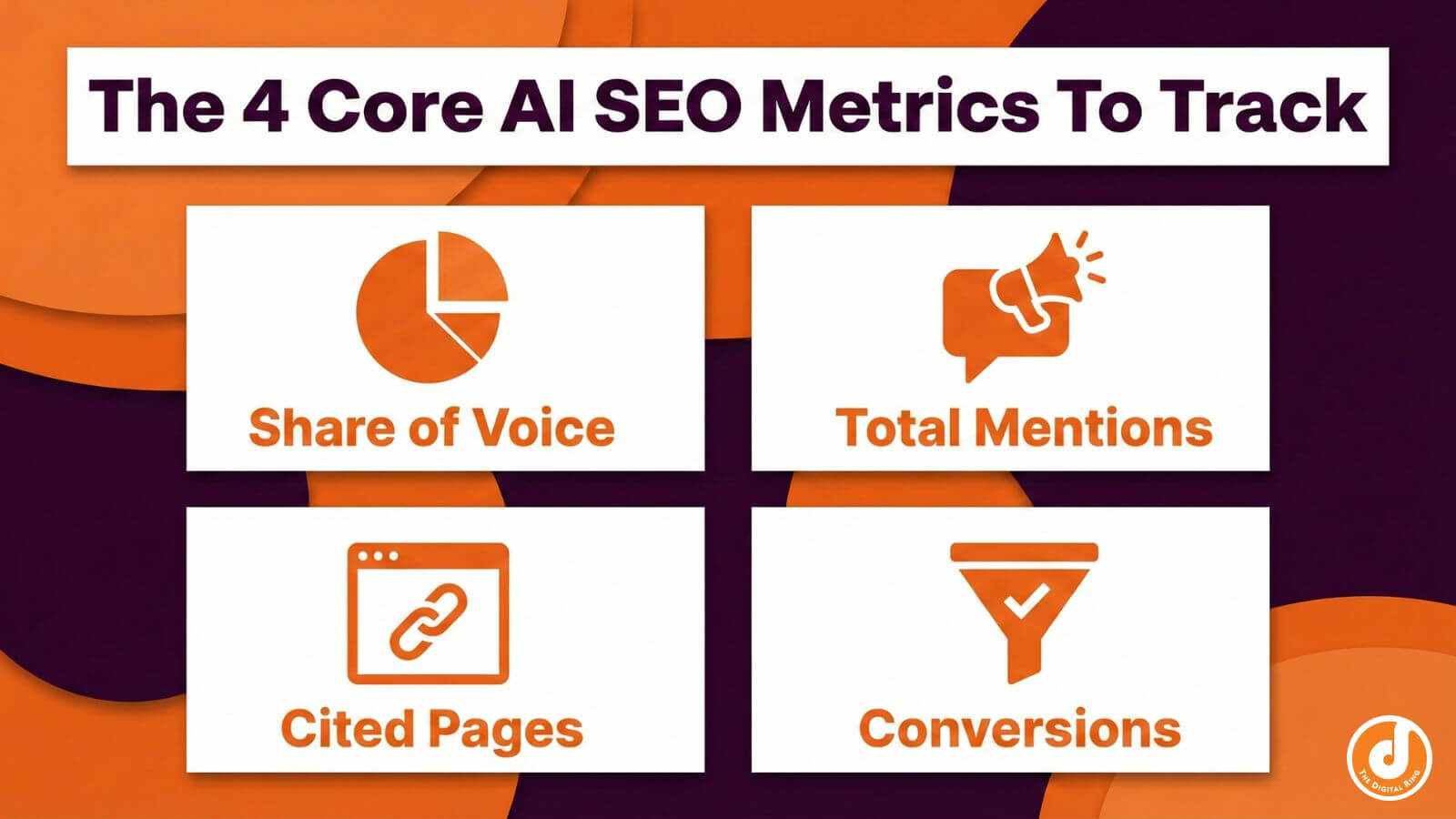
- Track presence, not position: Success evolves from “ranking #3” to measuring share of voice, total mentions, total cited pages, and conversions from AI-generated search results. Shift your idea of success from vertical placement to horizontal visibility.
- Start measuring now to compound later: Monthly publishing that targets citation gaps creates long-term momentum. AI search systems keep drawing from expanding content libraries, while slower competitors remain invisible.
- Technical foundations enable AI comprehension: Implement schema markup implementation through JSON-LD or microdata, allow AI crawlers full access, and optimize page speed below 200ms so answer engines can parse, understand, and confidently cite your content.
- Bottom-funnel content converts at 23x rates: AI-driven visitors arrive pre-informed and highly qualified, making comparison guides, buying resources, and other decision-stage content disproportionately effective for conversion.
- Multi-platform presence is non-negotiable: AI engines cite YouTube, press articles, Reddit, Wikipedia, and social media. This means that distributing and repurposing content across multiple channels becomes essential for broad AI SEO optimization visibility.
AI Search Requires Horizontal Scaling, Not Vertical Rankings
AI reshapes visibility. And if you try to solve this new world with old frameworks, you’ll burn time and budget climbing a ladder that doesn’t exist.
Traditional search has always been vertical competition. You’re fighting to move from #10 to #1. Ranking determines how much traffic you earn, and the SERP is a crowded stage with limited spots.
Here’s the big difference we’re seeing today: SEO for AI-driven search is horizontal. Large language models personalize answers based on user history, intent, and phrasing, creating infinitely variable responses. Your goal is to appear in as many answers as possible, whether users ask follow-up questions, rephrase queries, or shift from general to specific searches.
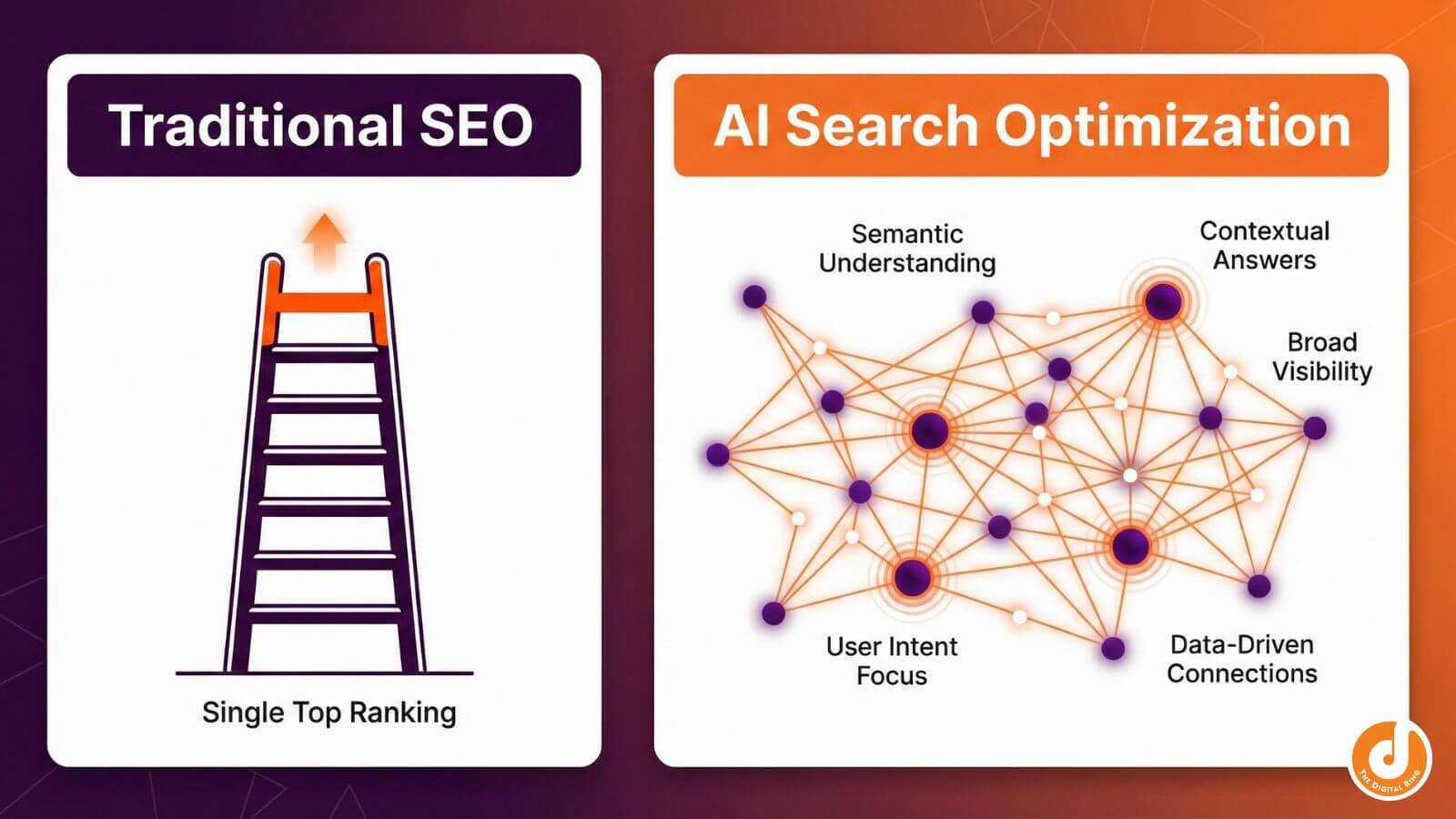
You can think of AI visibility as casting a net across a wide body of water, rather than spearing a single fish. You're building surface area. You're creating content that aligns with natural language, mirrors common questions, and offers concise, high-authority answers that AI can easily reuse. This is powered by natural language processing (NLP), which enables search systems to interpret meaning, context, and user intent from conversational queries. (Note: If you interested in spearing that single fish, consider using PPC.)
Consistency drives this. Publishing once a month may not feel groundbreaking, but each piece expands the footprint AI models rely on when building responses. As these platforms scale from millions to billions of daily decisions, your early entries accumulate authority and relevance, strengthening your topical authority signals—the depth and consistency of coverage across related subjects that demonstrate genuine expertise to AI systems.
Does AI Search Optimization Work? Start by Measuring Visibility
You can’t improve what you can’t measure — and most marketers aren’t measuring AI visibility at all. Before you rewrite content or overhaul your site, establish a tracking framework so you know how to monitor and optimize for ai search while knowing whether you’re gaining or losing visibility across AI platforms like ChatGPT, Perplexity, and Google AI Overviews.
Four AI SEO Metrics to Track for Visibility
- Share of voice: Measure the percentage of AI responses in your category that cite your brand versus competitors. It reveals how visible you are across ai search landscapes, not just where you appear.
- Total mentions: Track raw citations across platforms. More mentions indicate your content structure and authority signals are resonating with answer engines.
- Total cited pages: Monitor how many unique URLs from your domain appear in search results or AI answers. It’s a proxy for content depth.
- Conversions from AI traffic: According to these findings from ahrefs, traffic referred from AI tends to convert at up to 23x compared to traditional search. Users already consumed context in the AI response, so by the time they reach your site, they’re primed to take action.
To better understand the importance of these metrics, we consulted our resident SEO expert. Here’s what he had to say:
"The only true way to know if you're winning is to tie AI SEO success as close to revenue as possible. Google isn't the only playbook anymore; traffic sources are getting more diversified, and the number one thing you need to be looking for is traffic and engagement at the bottom of the funnel." - Riley Krutza, SEO Manager at The Digital Ring
Track AI Search Visibility Manually or With Advanced Tools
If you’re early-stage or working lean, start manually. Create 10-15 prompts related to your- field, test them weekly across ChatGPT, Perplexity, and Google AI Overviews, and track citations in a spreadsheet. It’s blunt but effective.
When you’re ready for scale, tools like Goodie AI, Profound, Gauge, and AthenaHQ offer platform-wide tracking, competitive analysis, and real-time feedback loops. They reveal citation gaps, highlight competitor advantages, and uncover topics AI platforms consistently cite—but not your content. Those citation gaps, competitor advantages, and uncited topics become opportunities to create high-leverage content.
You’ll also want to track branded searches. When AI mentions you without linking, users often Google you directly. A spike in branded volume is often the first signal of improving AI visibility.
How to Optimize Content for AI Search Engine Citation
AI systems gravitate toward content that is structured, direct, and aligned with the phrasing real users employ when asking questions. They evaluate contextual relevance signals—how well your content relates to surrounding topics, internal linking patterns, and semantic connections—to determine whether your content truly addresses user intent comprehensively.
Build Technical Foundations AI Crawlers Need
AI systems can't cite what they can't crawl or understand. Technical optimization gives AI the confidence to use your content repeatedly. Modern search engines use vector embeddings—mathematical representations of content meaning—to understand semantic relationships and match queries with relevant information beyond simple keyword matching.
- Allow AI crawler access: Make sure your robots.txt permits GPTBot, ClaudeBot, PerplexityBot, and OAI-SearchBot.
- Optimize page speed: A Time to First Byte under 200ms keeps crawlers engaged and boosts trust signals.
- Implement structured data markup strategically: Use schema markup formats like FAQ, HowTo, Organization, and Product schema. These structured data formats communicate structure, purpose, and value in machine-readable formats ideal for search engine interpretation and knowledge graph optimization—helping search engines understand your brand's relationships to topics, people, and entities for richer, more accurate representation in search results.
- Ensure comprehensive crawlability: Clean internal linking, eliminate broken paths, and submit updated sitemaps to maximize discoverability.
- Use semantic HTML markup: Implement proper HTML5 elements (article, section, header, nav) that convey content structure and meaning, helping both crawlers and AI systems understand page hierarchy and context.
This is the quiet infrastructure behind strong AI SEO optimization. Without it, even great content gets overlooked.
Use Answer-First Structure for Clear AI Citations
Leading with clear answers improves your chances of citation. AI systems scan for immediate resolution to user questions, then look for supporting details. This answer-first approach also benefits featured snippet optimization—structuring content so search engines can extract concise, direct answers for prominent display in traditional search results and AI responses.
Use question-based headings ("What is…", "How to..", "Why…") to match conversational search queries—the natural, spoken-style questions users ask AI assistants rather than traditional keyword searches.
Break content into 2-4 sentence paragraphs, use bullet points, and include FAQ sections. These give models easy-to-parse structures that outperform dense text blocks.
High-performing formats include:
- Q&A pages: Ideal for concise answers
- How-to guides: Perfect for step-by-step tasks
- Comparison tables: Clear and structured for evaluation queries
- TL;DR summaries: Great for skimmability and AI extraction
These formats support how to optimize for SearchGPT because they mirror how the model constructs responses.
Establish Authority Signals AI Recognizes
To get cited, your brand needs external validation. AI models rely on authority signals — backlinks, references, and contextual mentions — to determine trustworthiness. This aligns with E-E-A-T principles (Experience, Expertise, Authoritativeness, Trustworthiness), Google's framework for evaluating content quality that AI systems increasingly use to assess source credibility.
Create original research, publish proprietary data, and earn press coverage. These citation-worthy content types—substantive, unique, and verifiable information—are powerful signals for both traditional seo and answer engine optimization because they give AI systems authoritative sources worth referencing.
Don't ignore platforms like Wikipedia or Reddit. AI platforms frequently cite them due to their perceived neutrality, breadth, and recency. Being present on those platforms increases your chances of citation inside results pathways. For more info on citations, check out this article from Search Engine Land.
Prioritize Bottom-Funnel Content for Efficiency
Bottom-of-funnel content is where AI converts really well.
Build buying guides, implementation walk-throughs, product explainers, and comparison pages. Refresh high-traffic content before creating new material because AI tends to surface pages that have history, freshness, and authority.
When resources are tight, this is where they should go.
How to Optimize for AI Search Across Platforms, Not Just Google
You can’t rely on website content alone (although it’s important to make sure that’s solid, too). AI engines pull from everywhere: YouTube videos, press mentions, Reddit threads, and news interviews. The more channels you occupy, the more your brand appears in search results assembled by ai search engines.
Repurpose content across formats to widen your surface area:
- A blog becomes a YouTube script
- A webinar becomes a LinkedIn article
- A guide becomes a podcast episode
These create new citation pathways for seo for ai search engines and support discoverability across platforms.
Make omnichannel work for you by starting small. Repurpose across 2-3 channels first, then expand once workflows stabilize. Visibility in AI is cumulative, and the brands that scale horizontally now will dominate as answer engines become the default way users discover and evaluate solutions.
If you’re ready to build an AI-first visibility strategy, check out The Digital Ring’s SEO services. We’ll map exactly where you should show up and how to get there.
share this article


Get In touch
We’d love to share how digital marketing can help elevate your brand — and your business’s bottom line.


821 E Washington Ave #200
Madison, WI 53703
608.836.7464


