


SEO for New Websites: Rank with the Avalanche System
Launching a new website often feels like opening a restaurant on a quiet side street and hoping people wander in. You invest in design, content, and structure, then wait for Google to notice. For most new sites, that moment never arrives.
Roughly 96% of pages get no traffic from Google, not because the content is poor, but because new sites try to rank for keywords they don’t yet have the authority to compete for. They enter a crowded arena with no track record, no backlinks, and no relevance signals.
The Avalanche Technique solves that problem. It’s a tier-based framework that helps you identify the level where you can actually rank today, then climb upward with strategy instead of guesswork. Let’s break down how it works and how to use it to build steady momentum from day one.
The Foundational Five: What Every New Site Needs to Rank
Before we get into the mechanics of tiers and content mapping, it’s helpful to zoom out and understand the order of operations. Because order, for new websites, is everything.
Many site owners do the right things but do them in the wrong sequence. They publish aggressively before their technical setup is stable. They chase high-volume keywords before earning the right to. They track traffic long before traffic is the metric that matters.
So here’s the real sequence—the one that consistently gets new websites ranking:
.jpg)
1. Build a flawless technical foundation
This includes HTTPS, Core Web Vitals, crawlability, Search Console verification, and clean URL architecture. Without these, everything else is compromised.
2. Identify your natural competitive tier
Most sites guess. You test. That’s the Avalanche System.
3. Prioritize lower-funnel, actionable content inside your tier
You target searchers who already know what they’re looking for, rather than broad educational terms you can’t rank for yet.
4. Maintain a pyramid structure
Lower-tier content forms the base. Mid-tier content sits above it. High-tier content goes last. When you flip this pyramid, rankings stall.
5. Track authority, not just traffic
Traffic comes later. Ranking keywords come first. That’s your leading indicator.
These five steps will guide every decision you make moving forward. Now let’s unpack each layer in detail.
Technical Foundation: The Prerequisite for Competing
Think of Google as a massive warehouse of information. To get your pages stocked on the right shelves, Google needs to crawl, understand, and trust your site. That trust happens through technical clarity.
Many new websites skip this step because it feels tactical rather than “strategic.” But technical excellence is strategy. It determines whether Google even considers ranking you.
Search Console is your home base
Set this up right away by verifying your domain and submitting your sitemap. It shows how Google indexes your pages, flags issues, and tracks early performance. If something goes wrong, this is usually where you see it first.
HTTPS everywhere
Your entire site needs to load over HTTPS to meet modern security and trust standards. Google and browsers both treat HTTP as unsafe. Fix any remaining HTTP URLs before publishing more content.
Make your site easy to crawl
Small technical mistakes can block or confuse Google. Keep robots.txt, sitemaps, canonicals, and URL versions clean and consistent. When your structure is simple, Google can index your pages correctly.
Core Web Vitals matter more than ever
Google evaluates new sites partly through performance. Aim for fast load times and responsive pages so users stay engaged. Strong Web Vitals help your pages compete earlier.
Monitor everything proactively
Check tools like Search Console, Semrush, and PageSpeed Insights regularly. Routine monitoring helps you catch issues before they affect rankings. Treat technical maintenance as an ongoing habit.
The Avalanche Tier System: How New Sites Discover Their True Authority
Most SEO advice assumes you already have authority. But new websites don’t. You’re starting from zero—no relevance, no history, no backlinks, and no evidence that you belong on page one for competitive terms.
So how do you figure out where you can realistically compete?
That’s the point of the Avalanche System. Rather than guessing at keyword difficulty numbers or relying exclusively on competitive analysis, you test your true tier by publishing targeted content and watching how Google responds.
Think of keywords as altitude levels
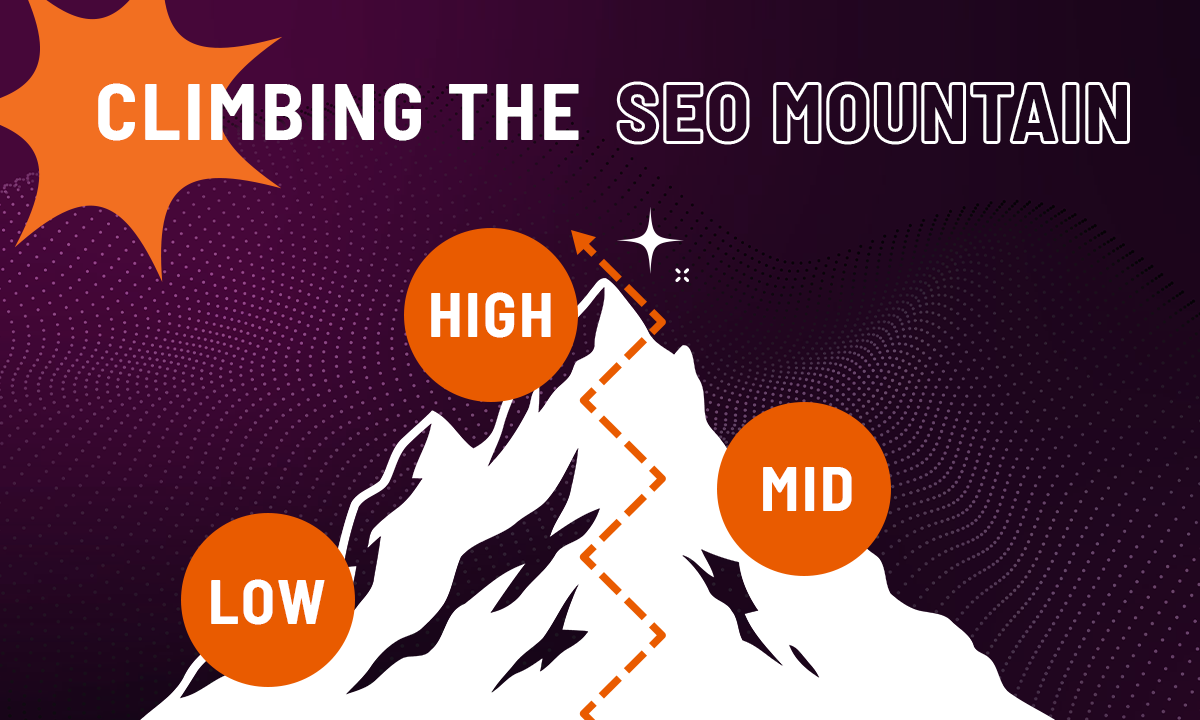
Low search volume sits at the bottom of the mountain with the least competition. Medium-volume terms sit halfway up the slope. Higher-volume terms sit at the summit, where competition is fierce. You don’t climb from the base to the summit in a single push—you acclimate to the altitude you can handle right now.
How to find your natural tier
Here’s your first experiment:
- Choose a ~100 searches/month keyword.
- Publish a clean, helpful article optimized for it.
- Wait 2–4 weeks.
- If you hit top 10, that’s your tier.
- If not, drop to 20–50.
- Still nothing? Try 0–20.
When you finally land in the top 10 without backlinks or heavy promotion, you’ve discovered the altitude where Google currently trusts you. That’s your basecamp.
Why this matters
Targeting keywords above your tier doesn’t get you penalized; Google simply ignores you. But being ignored still costs you something: time, energy, and the momentum you could be building by ranking where you can rank. When you stay inside your tier, you accumulate early impressions, clicks, relevance markers, and engagement signals that Google uses to judge authority over time.
Tier failure is diagnostic
If you can’t rank for even the smallest low-volume terms, that’s usually a sign of deeper issues—technical blocks, thin content, poor architecture, or nonexistent internal linking. These are fixable, and the sooner you identify them, the better.
Lower-tier rankings are “sticky”
When you rank for a small keyword without backlinks, Google is acknowledging your relevance for that micro-topic. These small wins don’t vanish easily because they’re rooted in content quality rather than domain power. They form the foundation you’ll build on.
Building Your Content Roadmap: Structure, Strategy, and Sequencing
Once your tier is clear, you can build a content roadmap—not a list of random ideas or a calendar built around arbitrary dates, but a strategic progression of content that grows your authority.
Step 1: Gather your keyword universe
Use tools like Semrush, Ahrefs, and Google Keyword Planner to capture every relevant keyword. If you’re an HVAC company, for example, you may see themes around basement moisture, crawl space humidity, dehumidifier sizing, sump pump maintenance, and vapor barriers. Don’t judge or filter yet. Just gather.
Step 2: Create a topic map
Group keywords into themes and subtopics. This helps you see where clusters naturally form, which topics deserve full landing pages versus supporting articles, and how each piece connects to the next. Google relies on these content clusters to determine whether you’re a true authority, and users appreciate the organized, intuitive structure.
Step 3: Label each keyword by tier and funnel stage
This is where strategy becomes visible.
Tier levels:
- Tier 0–20: easiest wins
- Tier 20–50: your next competitive level
- Tier 100+: aspirational keywords for later
Funnel stages (a separate layer you’ll map across tiers):
Awareness → Consideration → Decision
You’ll quickly notice that decision-stage terms often sit in lower tiers, which is why they’re typically the best place to start when your site is new.
Step 4: Prioritize lower-funnel searches
These searches come from people who already know what they want—meaning they’re more likely to convert and more likely to send strong user-engagement signals back to Google. For example, “best dehumidifier size for crawl space” is far more actionable than “what is a dehumidifier?” and far more aligned with what a new site can realistically rank for. These visitors also transition more cleanly into a structured sales prospecting process, since their intent is already well-defined.
Step 5: Interlink with intention
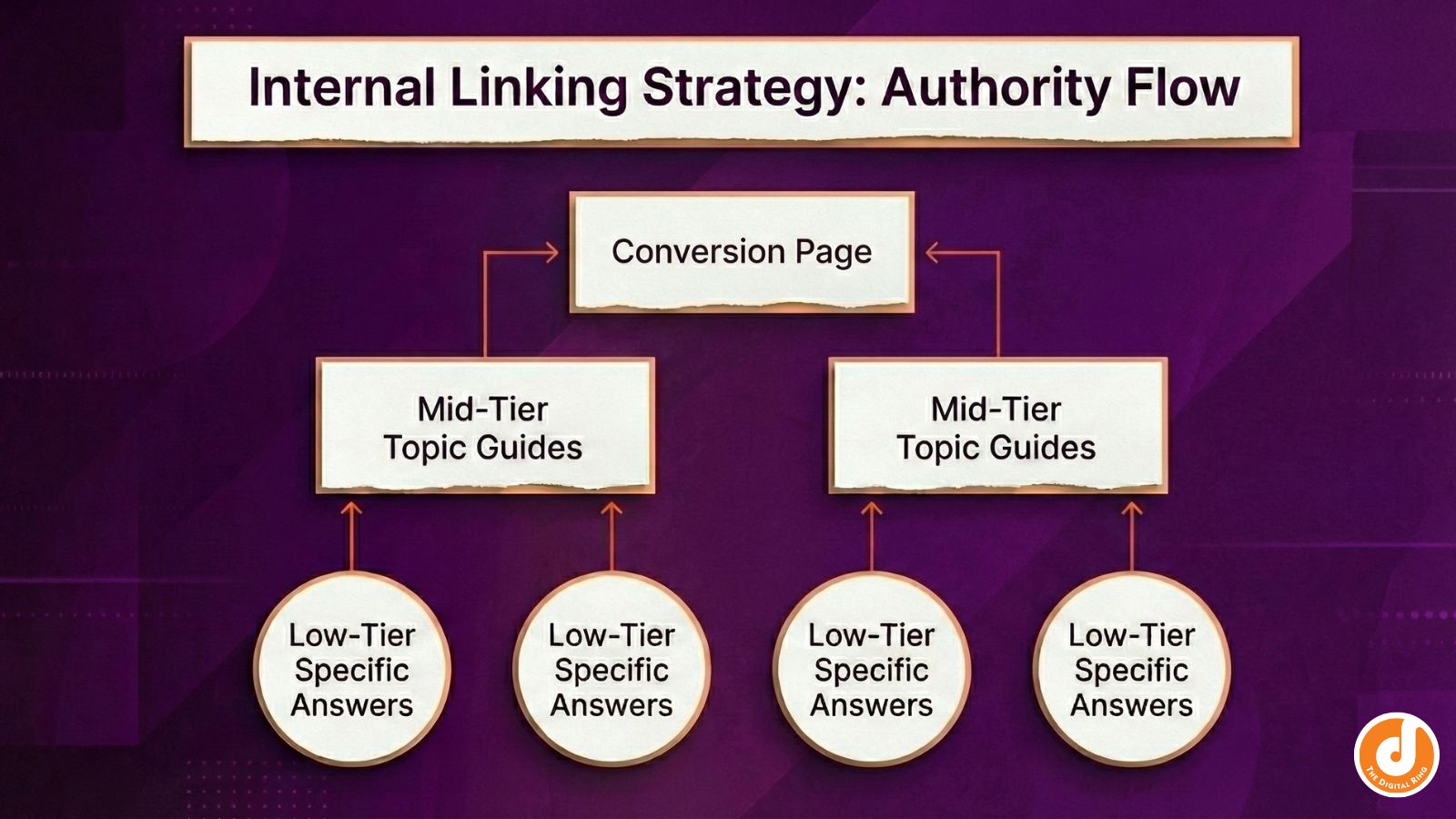
Lower-tier content supports mid-tier pages. Mid-tier supports your core conversion pages. Internal links help Google understand this hierarchy and distribute authority across your site strategically.
Executing Consistently: Why “Slow and Steady” Beats “Fast and Sporadic”
Once your roadmap is ready, the goal is simple: publish quality content inside your tier consistently. Frequency matters less than rhythm. Google wants to see a steady pattern of value delivered over time.
Quality > quantity
Publishing three comprehensive, well-interlinked articles a month will reliably outperform pushing out daily thin posts that lack depth.
E-E-A-T is your reputation layer
As you publish, reinforce your credibility however you can. Clarify who wrote each piece and why they’re qualified. Cite reputable sources. Provide transparency about your business. Add examples that show true subject-matter understanding.
Cover your tier deeply before moving up
Many new sites get impatient and chase higher-volume keywords too early. Stay focused. When your rankings show upward movement, that’s your signal to climb.
Reality Check: Timelines, Expectations, and Momentum
One of the most important mental shifts for new website owners is understanding that SEO rewards consistency, not speed. Paid ads deliver immediate feedback. SEO builds durable, compounding growth.
Authority beats age
Some site owners blame the “sandbox” for slow results, but evidence doesn’t support the idea of a formal waiting period. Google rewards authority—accumulated relevance, quality, and trust—far more than age. If you match your tier, you can rank within weeks.
Expect 3–6 months before meaningful traction
Your early signals will look like this: your first clusters of ranking keywords, impressions rising for tier-matched queries, low-tier content stabilizing in the top 10, and mid-tier content creeping upward. Growth starts subtle, then compounds—especially when your broader lead generation systems are built to capture the demand your content starts generating.
Track the metrics that actually matter
Early on, don’t obsess over traffic. Focus instead on the number of keywords you’re ranking for, how those rankings evolve, and whether your crawl health remains strong. Keep an eye on conversions from bottom-funnel content—those are usually the first signs your strategy is gaining traction. As that early intent turns into real leads, a thoughtful drip email sequence helps nurture those contacts and guide them toward becoming true opportunities.
Final Takeaway: How New Sites Actually Win
Most new websites fail at SEO not because they’re doing the wrong things—but because they’re doing the right things in the wrong order.
Your path is clearer now:
- Strengthen your technical setup
- Find your real competitive tier
- Build depth at the base
- Publish strategically, not randomly
- Track authority growth
- Climb steadily
The Avalanche System gives your new site structure, clarity, and momentum. It replaces guesswork with intentional steps.
If you want help mapping your tiers, organizing your keyword universe, or building a content roadmap that actually fits your authority, The Digital Ring does this every day.
Get in touch—we’ll help you build something that ranks and lasts.
share this article

Get In touch
We’d love to share how digital marketing can help elevate your brand — and your business’s bottom line.


821 E Washington Ave #200
Madison, WI 53703
608.836.7464


