


Designing Email Drip Campaigns That Actually Convert
Most companies build drip campaigns the way some people (including yours truly) throw together a weeknight dinner: grab whatever ingredients are lying around, mix them quickly, set a timer, and hope it turns out edible (or, in this case, actually converts).
But the truth is simple. A drip campaign is only as strong as the strategy beneath it. And most drip campaigns aren’t strategic. They’re just… sequenced.
When you treat email like a “send this, then that” checklist, you get what everyone else gets: a mildly engaged audience and a pipeline that never seems to accelerate.
But when you treat email like a guided path, something your prospects walk step-by-step with purpose, everything changes.
Let’s build something that actually converts.
Before You Write a Word, Figure Out What’s Broken
Every drip campaign should start with one question: Where do your prospects get stuck?
Not “What do we want to tell them?”
Not “How many emails should we send?”
Not “What subject lines get the best open rates?”
You begin by diagnosing your bottleneck because that bottleneck is the entire reason your campaign exists. If your leads request demos but never book them, your campaign should solve that. If they book demos but never move to evaluation, your campaign should solve that. If they stall at pricing because ROI feels fuzzy, your campaign should solve that.
Once you understand the stall point, you define the single action that moves them forward. That becomes the heartbeat of your entire sequence. Think of it as the magnetic north your drip campaign points toward.
Everything else is noise.
Stop Designing for Timelines. Start Designing for Intent.
Most drip campaigns are built around time.
Day 1: Welcome email.
Day 3: Follow-up.
Day 10: Case study.
Day 14: CTA.
This creates structure, sure. But it doesn’t create momentum.
Momentum happens when your email matches what your reader is trying to do at that moment. That’s intent-based nurturing. And it’s a whole different game.
A prospect in discovery mode wants clarity.
A prospect comparing vendors wants proof.
A prospect nearing a decision wants reassurance.
Your content isn’t valuable because it arrives on schedule. Your content is valuable because it helps someone make progress.
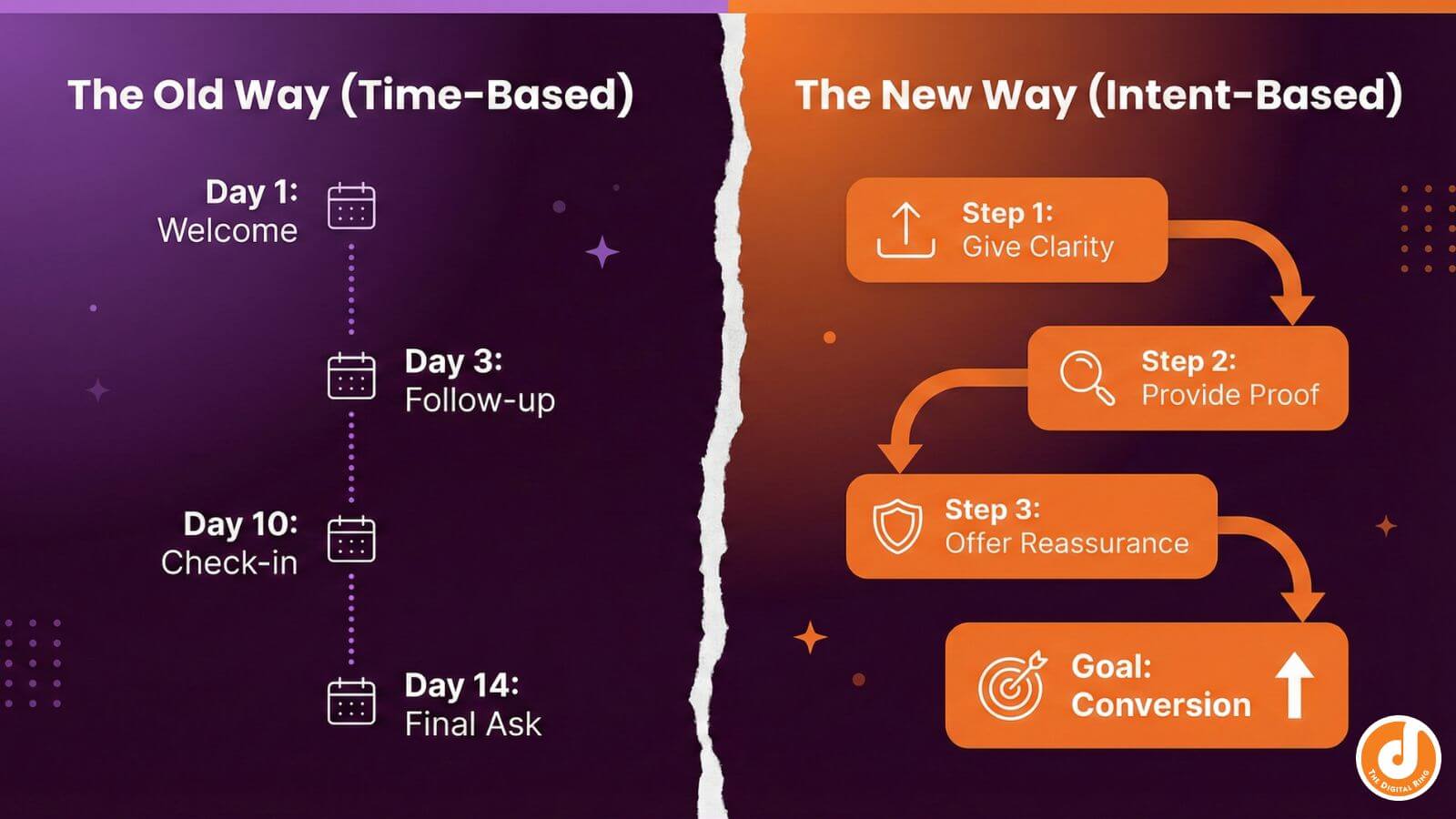
So instead of asking, “What goes in Email Three?” ask: “What is my prospect trying to accomplish next—and how do I help them get there?”
That’s how you design a sequence that feels like guidance, not noise.
Design Emails That Actually Move People Forward
Once you know the bottleneck and the prospect’s intent, you can finally write. But now you’re writing with purpose instead of guessing. Here’s how your drip becomes a conversion engine.
Pace That Feels Natural
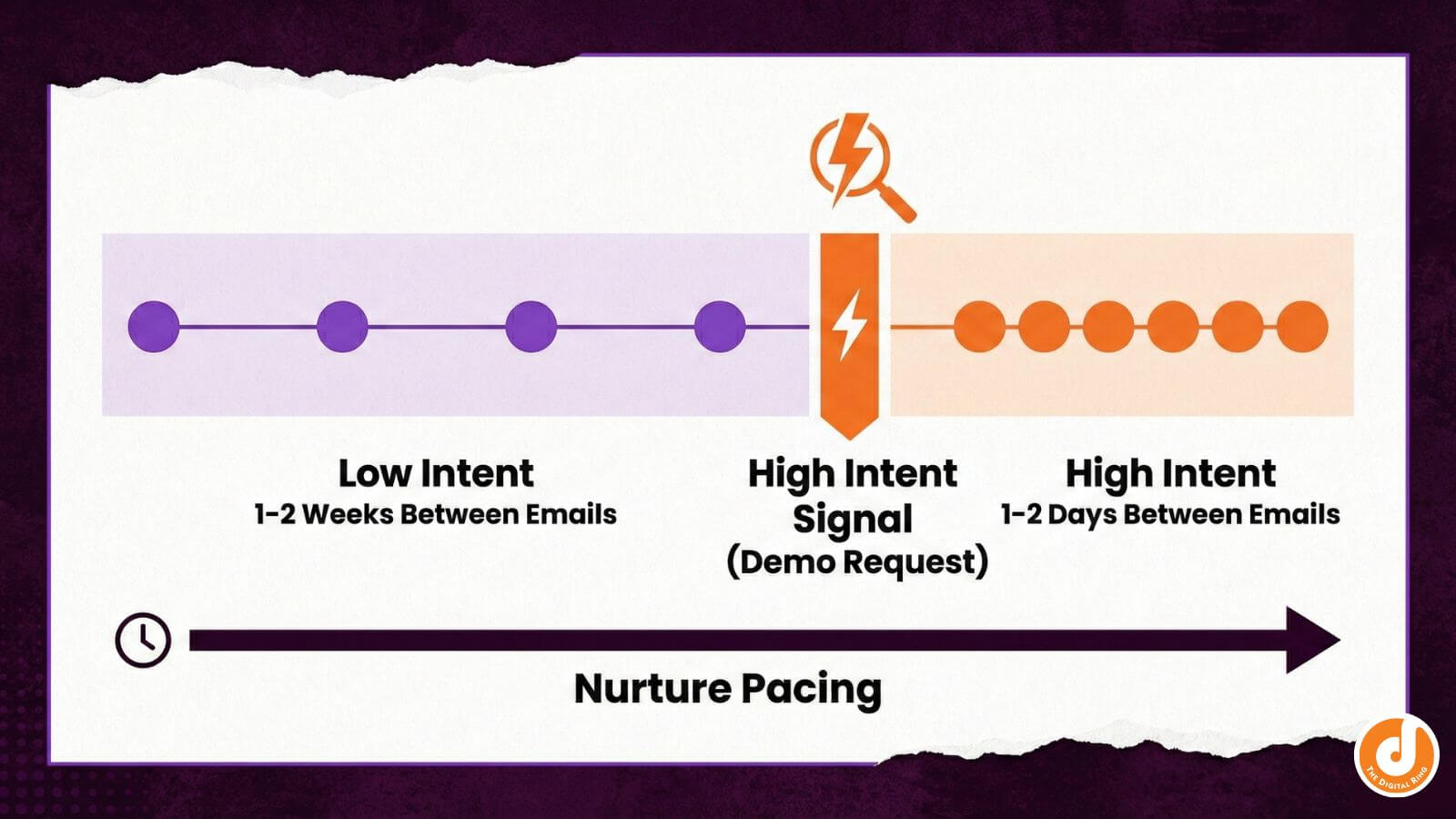
Early-stage readers don’t need daily emails. Give them space. One to two weeks between touches works well. But when intent rises—like a demo getting scheduled—you tighten the spacing so guidance arrives at the exact moment they need it.
It should feel like a helpful nudge, not a pushy tap on the shoulder.
Clarity Always Beats Complexity
The best drip emails are easy to skim, quick to understand, and obvious about what the reader should do next. Plain-text often outperforms HTML because it looks like a real message from a real person.
Your reader’s brain decides within seconds whether to stay or bounce. Make those seconds count.
Make Your Email a Smooth Reading Experience
Short paragraphs. Clean spacing. Strong opening lines.
Think of your email like a well-marked trail. The reader should glide from point to point without effort. When the eye has to work, the mind checks out.
Personalize Beyond “Hi {First Name}”
Real personalization is connecting the dots:
You downloaded this.
You’re trying to solve that.
Here’s something that helps you take the next step.
When your email reflects their world—not your agenda—it becomes hard to ignore.
One Email, One CTA
This is the rule that instantly increases conversion: Each email asks for exactly one thing. No menus. No “while you’re here.” Just one clear next step that ties to one meaningful benefit.
That’s how you create action, not distraction.
Measure Success by Behavior, Not Vanity Metrics
Open rates feel good, but they don’t tell you much. Click-through rates feel better, but still not enough. The only metrics that matter are tied to action.
Measure CTA Conversion for Each Email
If an email exists to book consultations, you measure booked consultations. That’s your leading indicator—your most honest feedback loop. Rewrite the emails that miss. Scale the ones that perform.
Look at Deal Quality and Deal Velocity
The real magic shows up inside the sales process. A good drip campaign creates prospects who show up prepared, informed, and confident. Sales conversations get smarter. Timelines shrink. Objections change. Momentum builds.
That’s the impact of strategic nurturing.
Use Behavior to Adapt the Journey
When someone always opens but never clicks, send them deeper examples.
When someone never opens, test a new angle or approach.
When someone clicks but doesn’t convert, lower the friction on the ask.
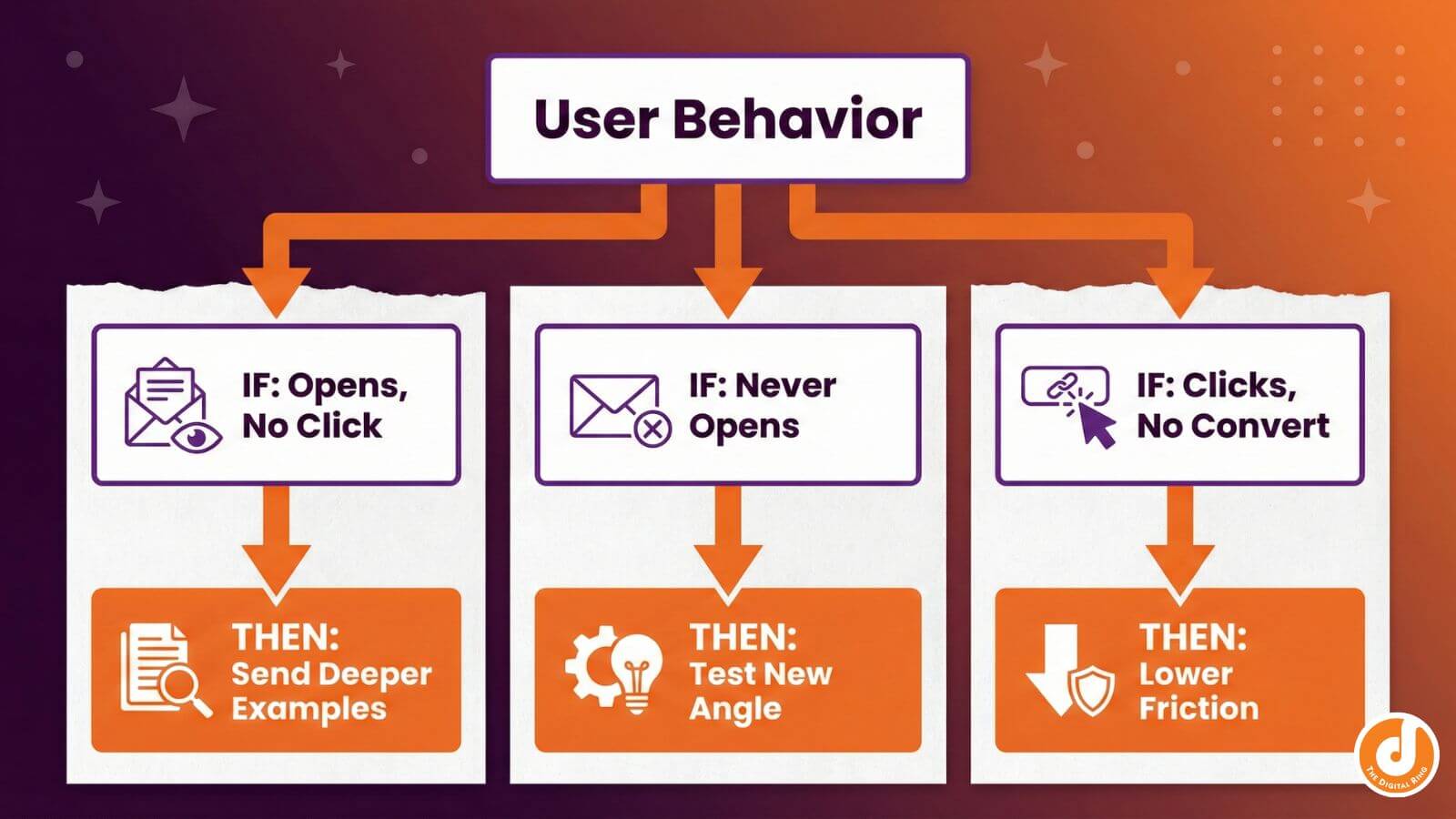
High-performing drips adapt. They flex. They respond. They treat prospects like humans with different patterns of readiness—not identical subscribers marching through the same assembly line.
Watch Unsubscribes Like a Feedback Monitor
Every unsubscribe is data. If one email triggers a spike, something missed the mark—tone, timing, ask, or relevance. Don’t panic. Investigate.
A smart drip designer treats unsubscribes like signals on a dashboard. Quiet indicators of where refinement is needed.
The Real Power of a Drip Campaign
A great drip campaign doesn’t feel like automation. It feels like mentorship. It feels like a guide who shows up at the right moment with the right insight, helping your prospect take the next step with confidence.
When you build your campaign around the prospect’s goals instead of your own deadlines, you don’t just nurture leads. You build trust. You build momentum. You build a pipeline that moves without you having to push.
Drip campaigns shouldn’t feel like marketing. They should feel like progress.
So diagnose your bottleneck.
Design around intent.
Write each email as a stepping stone.
And measure the actions that truly matter.
That’s how you build a drip campaign that doesn’t just convert—it compounds.
share this article

.jpg)

Get In touch
We’d love to share how digital marketing can help elevate your brand — and your business’s bottom line.


821 E Washington Ave #200
Madison, WI 53703
608.836.7464


