


How to Use AI for Sales Prospecting With a Human Touch
AI promised to make prospecting easier…but has it? Sure, we’ve gotten faster research, cleaner data, and even personalized outreach at scale. AI can even boost productivity by 30% and give reps two or more hours back in their day. But here’s where it gets tricky: As AI makes prospecting more efficient, it often makes it less effective.
In other words, automation speeds things up, but it also makes everything look the same. You’ve probably seen the patterns yourself. The perfect formatting, the predictable hooks, the “I saw you’re the Head of Growth at…” opener. AI delivers volume, but humans deliver connection. And in sales, connection is the real currency — and the thing that actually helps you close deals.
So the question isn’t whether you should use AI (you should!). The question is how to use it without losing the creative spark that actually closes deals.
This guide gives you the blueprint.
The Short Version (If You're Already Sold on AI)
- Start with CRM integration and data quality: AI only works if your systems are clean, connected, and free of data silos.
- Deploy AI on your biggest time drains first: Automate research, enrichment, and follow-ups before anything else.
- Humanize your automation by breaking patterns: Slight imperfections and unexpected touches make outreach feel personal.
- Measure conversion quality, not activity volume: More emails don’t equal better results. Quantity over quality, as they say.
- Invest in emotional intelligence and creative strategy: As AI handles execution, your value shifts to understanding people and crafting meaningful messages.
AI Handles Volume, Humans Handle Nuance
This right here is the heart of modern prospecting.
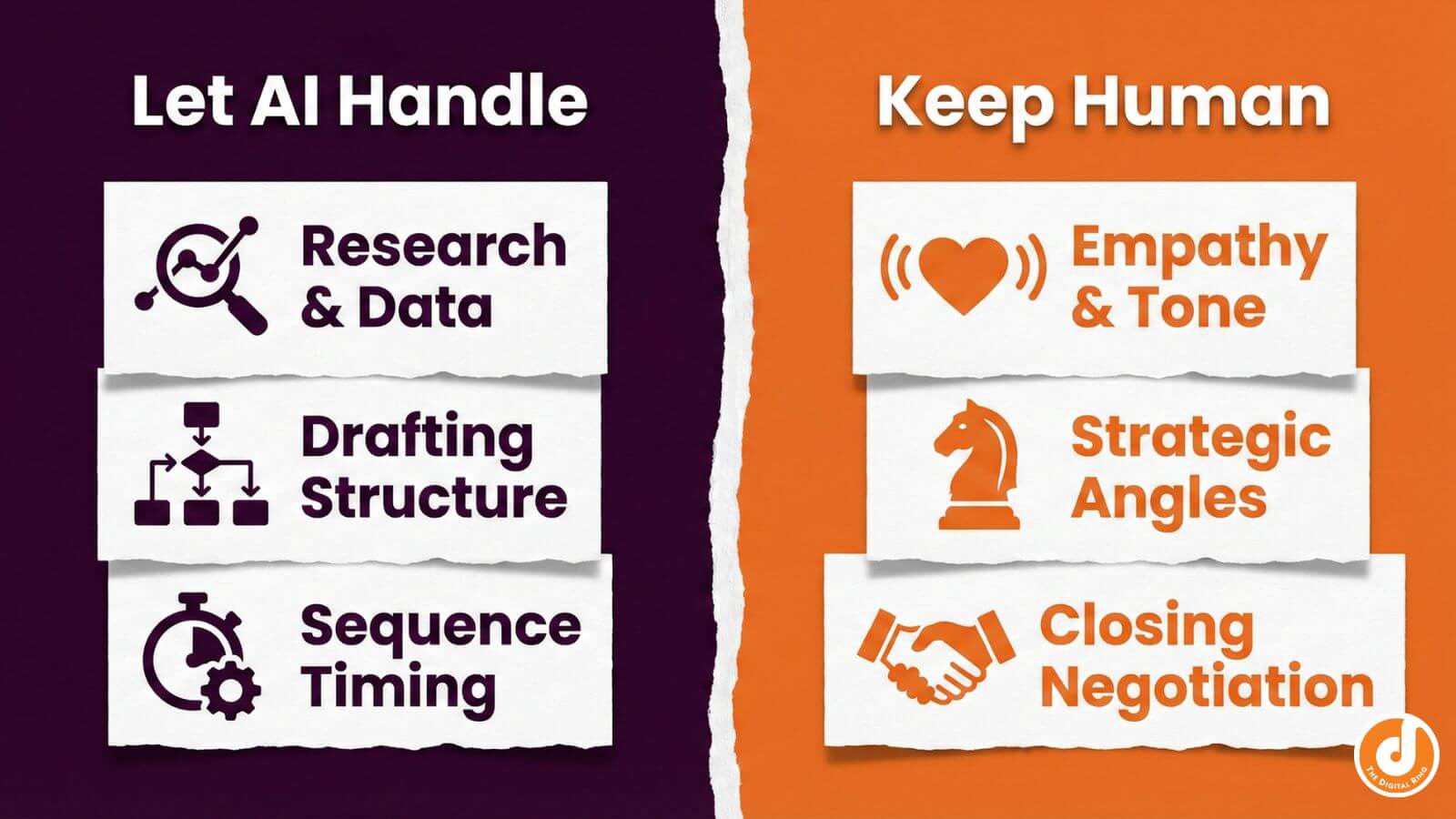
AI is brilliant at pattern recognition. It can pull company data, scrape job changes, scan press releases, summarize key accounts, and sequence thousands of touches without breaking a sweat — accelerating lead generation at a scale no team could match manually. But pattern recognition is also its weakness, because prospects feel the pattern too.
If every SDR uses the same “personalization at scale” tools, everyone ends up sounding identical. The volume increases and the effectiveness drops.
Sales professionals already spend only 28–30% of their time actually selling. The rest disappears into research, admin, CRM cleanup, and manual prospecting. AI fixes that part. It gives you the hours back.
But it can’t replace what makes people buy: intuition, creativity, tone, timing, and the moment you say something that breaks the script in their heads — the same skill set that anchors an effective sales prospecting strategy.
That’s why the best teams use AI to create space for strategic thinking instead of replacing human thinking entirely.
Bad Data and Disconnected Systems Kill AI Prospecting Before It Starts
Most AI prospecting breakdowns happen when teams build automation on top of shaky infrastructure.
Here’s how to avoid that trap.
Your CRM Is the Backbone. If It's Broken, Everything Downstream Breaks Too.
When your CRM systems don’t talk to each other, everything falls apart, and proven content fails to surface at the right time. Activity logs are incomplete and reps end up copying CRM data manually, defeating the point of automation. Integration is what keeps your sales pipeline, outreach, and reporting aligned. Getting this right upfront is critical. If you’re working through setup or adoption challenges, our HubSpot implementation best practices guide breaks down how to build a system your team will actually use.
AI Is Only as Good as Its Data Source
Predictive analytics, lead scoring, personalization, and account insights require high-quality contact data. Demographic, firmographic, technographic, intent signals like website visitors and content downloads… all of it must come from accurate, frequently updated sources. Many platforms pull from databases with 300M+ verified B2B leads. That’s the scale you need for reliable modeling.
If the Tool Forces You Into Templates, You're Just Noise
The more flexible your tool, the more room you have for clever human touches. The worst prospecting systems force everyone into the same templates. The best ones give you room to break patterns, experiment, and craft outreach that competitors can’t reverse engineer.
Bottom line: Get the infrastructure right before you layer automation on top.
Where to Start When You Automate Sales Prospecting With AI
The biggest mistake teams make is trying to automate everything at once.
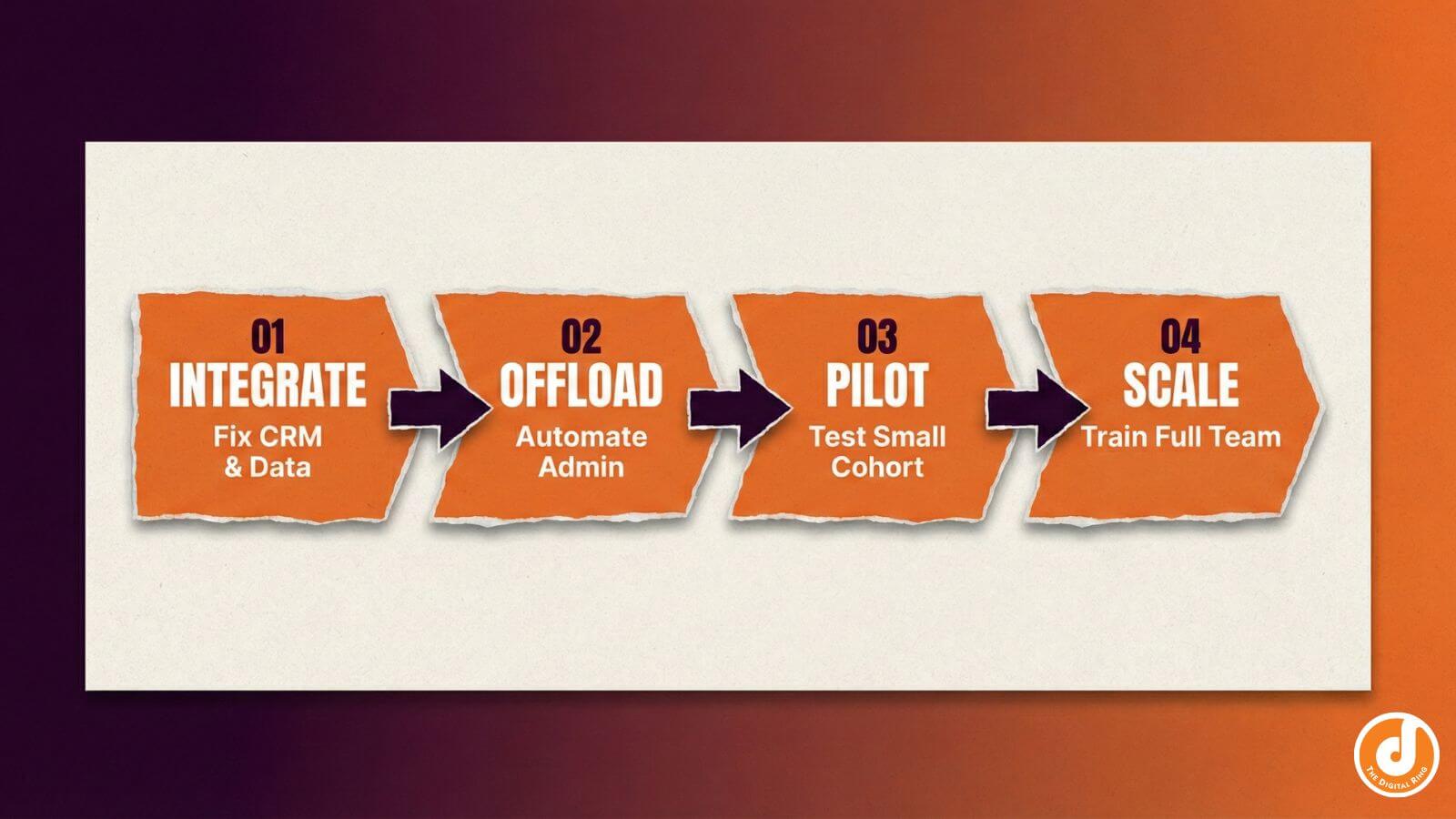
AI prospecting works best when you start with one or two high-impact areas, the tasks that take time away from actual selling.
The Tasks Worth Automating First
Focus on the time drains:
- Manual research and manual prospecting
- Updating CRM records
- Data enrichment
- Repetitive follow-up sequences
- Manual tasks like data entry and status updates
These are the quickest wins. Automating them frees up real selling time and creates momentum for deeper automation later. If you’re thinking beyond prospecting and into full-funnel automation, our guide on setting up an automated sales funnel walks through how to connect these pieces into a cohesive system.
Pilot Before You Roll Out. Nobody Follows a Top-Down Mandate.
Tool selection should reflect how your team operates. Some teams prefer modular tools for flexibility, while others benefit from an all-in-one platform that manages the entire outbound workflow.
Before scaling, run small pilot programs. Give a handful of reps access, let them test, and refine the process based on real results. Sales leaders should evaluate outcomes before any broader rollout. You’re looking for internal proof here. Nobody likes a top-down mandate.
Training is just as important. AI adoption often stalls because it requires reps to change long-standing habits. Ongoing support and clear expectations make that transition easier.
Start small, build trust, and scale strategically.
A Step-by-Step Look at How to Use AI for Sales Prospecting
So, what does this actually look like in practice?
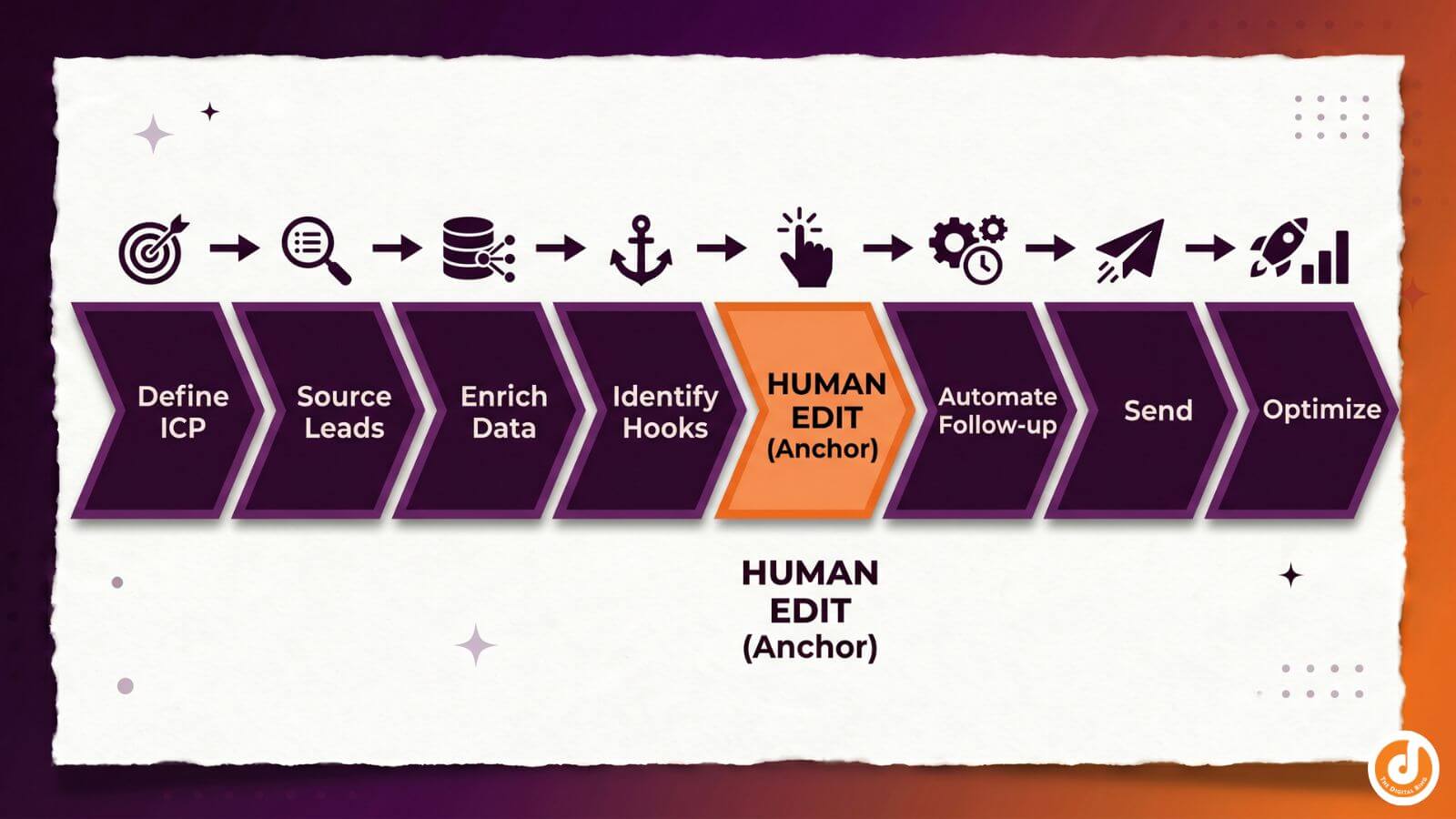
The goal is to build a repeatable prospecting process where AI handles the heavy lifting and humans shape the message. This is how you automate sales prospecting with AI without losing control of the message. If you’re looking at the bigger picture, our guide on what sales automation actually looks like breaks down how this fits into your overall sales process. For now, here’s a simple way to approach it.
A Repeatable Workflow Your Team Can Run Tomorrow
Think of this as your baseline system:
- Build your ideal customer profile (ICP) and filters: Define who you’re targeting based on firmographics, role, industry, and intent signals
- Use AI to find leads: Platforms surface new leads and handle list building at scale, surfacing contacts that match your criteria
- Enrich with context: Pull in recent activity like funding, hiring, tech changes, or product launches
- Generate personalized angles: Use AI to identify relevant hooks based on that context
- Draft outreach: Create a first-pass email or message using AI
- Human edit: Refine tone, simplify language, and add something that breaks the pattern
- Automate follow-ups: Let AI handle sequencing and timing
- Track and optimize: Monitor what actually leads to conversations and iterate
The Prompts That Produce Useful Output
AI is only as good as what you ask it to do. Clear prompts produce useful output.
A few examples:
- “Summarize this company’s recent activity and identify one potential challenge they might be facing.”
- “Write a short cold email referencing [recent event] and connect it to [our solution]. Keep it under 75 words.”
- “Based on this ICP, suggest three personalized outreach angles that would feel relevant, not generic.”
This Is What Separates AI Outreach From Human Outreach
AI-generated outreach often sounds right, but feels off. Here’s an example of how email outreach shifts when a human steps in:
AI-generated example:
“Hi [Name], I saw you’re the Head of Growth at [Company]. I thought you might be interested in improving your marketing performance.”
Human-improved version:
“Hey [Name]! Noticed you’re hiring for two growth roles AND rolling out a new product line. Curious how you’re thinking about scaling demand without overloading your team.”
See the difference? It’s specificity. AI is good for defining the structure, but you add the observation that proves you’re paying attention.
A Rep's Day When AI Handles the Research
Here’s what this looks like for a rep:
- Morning: Review AI-sourced leads and prioritize based on intent signals
- Midday: Generate outreach drafts and refine the strongest angles, reducing manual effort in the process
- Afternoon: Send messages and respond to replies
- End of day: Review performance insights and adjust targeting or messaging
Instead of spending hours researching, the rep spends time deciding what’s worth saying.
The Four Tools That Cover Most Teams' Needs
You don’t need a complex setup to get started.
A basic stack might look like:
- Clay: Aggregates and enriches data from multiple sources
- Apollo: Finds and filters contact lists
- ChatGPT: Generates summaries, angles, and draft messaging
- Lemlist: Handles sequencing, sending, and follow-ups
Each tool plays a role. Together, they create a system that balances scale with control.
The AI Prospecting Tools Worth Evaluating
Here’s a quick snapshot of the AI prospecting ecosystem and how each category fits into your workflow.
What Each Category Actually Does
Most teams don’t need dozens of tools. They need the right mix across a few key functions:
- Lead intelligence platforms: Tools like Cognism and Apollo.io surface verified contacts — including phone numbers and direct emails — using filters like industry, company size, job title, and intent signals, helping you focus on high-probability opportunities
- Data enrichment platforms: These tools, such as Clay, pull real-time signals — including website visits, tech stack changes, hiring activity, funding, and press mentions, giving your outreach meaningful context
- Email automation tools: Platforms like Instantly and Lemlist support personalization at scale with features like domain warming, multi-inbox sending, and automated follow-ups to protect deliverability
- Full-cycle AI SDRs: Tools such as Artisan’s Ava and AiSDR handle entire outbound prospecting workflows using natural language processing to generate messaging, including sourcing, enrichment, scheduling, and follow-ups
Most Teams See Results in the $100–$700/Month Range
Free tiers exist, but most teams see meaningful results in the $100–$700 per month range, depending on control and scale. Enterprise platforms like Gong or ZoomInfo operate on custom pricing models.
Remember, you don’t need everything. Prioritize the tools that match your workflow.
Scale Gets You In the Door. Human Touch Gets You the Meeting.
This is the part most teams forget.
AI gives you scale. But scale is useless if you sound like everyone else. Your job is to make your sales outreach feel human in a sea of automation.
Specificity Is What Makes Outreach Feel Personal, Not Generic
The best outreach feels natural. Small details like a lowercase opener, a casual phrase, or an unexpected tone signal authenticity and help you stand out.
Personalization matters, but only when it’s grounded in real context. Go beyond names and titles. Reference something specific: a recent hire, a product launch, a funding round, or a shift in their tech stack. That’s the kind of thing that proves you’re locked in.
H3: Break the Pattern
AI creates consistency, but you need to create contrast.
Shorter emails, unexpected questions, or a single line that clearly understands a prospect’s pressure can break the pattern and earn attention. Don’t aim for more messaging, but rather for more memorable messaging.
Segmentation plays a role here, too. Different roles, industries, and company stages require different angles. AI can make segmentation easier, but it’s up to you to use it intentionally.
Let AI Do the Prep. Show Up Human at the Moment That Counts.
Let AI handle the heavy lifting: research, enrichment, and structure.
You need to step in at the moment of contact, when a prospect decides whether you’re worth their time. That’s where tone, timing, and creativity — the things that make us human — can be the difference.
This is where deals are made.
Stop Tracking Activity. Start Tracking Pipeline Quality.
AI gives your team more data than ever, but that only helps if you’re watching the right signals. Instead of tracking everything, the goal is to monitor the few indicators that actually show whether your sales cycle and process are getting stronger.
Is AI Actually Freeing Up Selling Time? Here's How to Know.
Look at how many prospects AI sales agents can dig up for you, how many follow-ups it can handle on its own, and how much selling time it gives back to your reps. Those numbers tell you whether AI is truly freeing up your team or just adding noise.
More Emails Isn't the Goal. More Qualified Meetings Is.
More outreach doesn’t mean more revenue. Lead qualification is the real lever. What matters is how many conversations lead to real opportunities with qualified leads. Teams that focus on conversion rates and qualified meetings—tracking how many potential customers book meetings rather than how many emails go out—usually see customer acquisition costs drop because they’re spending time with the right people.
The Data Only Helps If Your Reps Actually Use It
AI tools can flag high-intent leads or suggest the best next step, but the value only shows up when reps actually use those insights and analyze historical data. When teams act on that sales data, the models get better and the results improve. When they ignore them, nothing changes.
The Rep Role Is Shifting. Strategy and Judgment Are What Win Now.
AI is shifting the rep role from executor to strategist.
The reps winning today use AI for research, enrichment, sequencing, and analytics—the work that historically consumed their selling hours. They spend their reclaimed time crafting sharper sales strategies, building customer relationships, and reading prospect psychology.
The reps who will win tomorrow will do something different: They’ll use AI as leverage, while excelling in areas AI can’t touch:
- Emotional intelligence
- Creative problem-solving
- Pattern-breaking communication
- Strategic outreach sequencing
- High-trust relationship building
AI can dramatically elevate your sales process by automating repetitive tasks, but only if you build the right foundation, deploy it intentionally, and infuse the human spark that automation can’t replicate.
Your Team Can Run This System. Here's Where to Start.
AI can dramatically elevate your sales process, but only if you build the right foundation, deploy it intentionally, and infuse the human spark that automation can’t replicate.
Your path from here is clear:
- Strengthen your CRM
- Automate your biggest time drains
- Humanize your outreach
- Measure real impact
- Develop the skills AI can’t replace
The sales teams who combine intelligence with intuition—who use AI for scale but keep the human unpredictable—will dominate the next decade of prospecting.
If you want help refining your prospecting strategy or implementing AI tools that actually fit your workflow, get in touch or explore our sales enablement services. We can guide you. Let’s build something your competitors can’t copy.
share this article
.jpg)

Get In touch
We’d love to share how digital marketing can help elevate your brand — and your business’s bottom line.


821 E Washington Ave #200
Madison, WI 53703
608.836.7464


