


How to Align Your SEO Strategy with Your Go-To-Market Plan
Aligning SEO strategy with your go-to-market plan is one of the highest-leverage decisions a marketing team can make before a launch. Most GTM teams treat SEO as a long-term brand play. They assume it won't move the pipeline during a launch window, so they prioritize paid media, outbound sales, and short-term demand generation instead. That mindset leaves organic acquisition untapped when it matters most.
SEO should be building qualified traffic before your launch date. When you integrate SEO three to six months before a release, you create infrastructure that you activate at launch instead of rebuilding from scratch. You're flipping a switch on traffic that already exists.
Search data also validates demand before you commit major GTM resources. Keyword research shows what your ideal customer profile actually searches for, not what your product roadmap assumes they care about. That insight shapes product positioning, messaging, and even feature prioritization while you still have time to adjust.
This guide walks through how to treat SEO as pre-launch infrastructure, how to use search intent analysis as market intelligence, and how to align SEO for go-to-market teams around shared revenue outcomes.
Key Takeaways: What You Need to Know Before Launch
- Build SEO infrastructure 3–6 months before launch: Create traffic to solution-aware content so launch day becomes adding CTAs to pages that already rank, not starting from zero.
- Use search data as market validation: Keyword research reveals how your ideal customer profile (ICP) describes problems and solutions, informing product positioning before launch resources are locked.
- Prioritize bottom-funnel content first: AI answers generic questions instantly, so focus on solution-aware and comparison queries inside your launch window.
- Cluster keywords by buyer journey trigger points: Map content to problem-aware, solution-aware, and comparison searches tied to real decision moments.
- Align around shared metrics: Coordinate SEO, sales, and product on traffic patterns and CTA engagement, not vanity metrics like rankings.
These are best practices for aligning SEO with go-to-market strategy that separate strategic growth from scattered content efforts.
SEO Is Pre-Launch Infrastructure
Anyone in marketing can tell you that successful product launches rarely begin on launch day. They start months earlier with infrastructure that compounds over time. SEO functions as that infrastructure.
For every successful product launch, four others fail — often because of poor product-market fit and weak GTM planning. Organic search offers a feedback loop before you commit heavily to paid channels or outbound campaigns.
Most GTM teams work on three- to six-month launch windows. SEO takes months to compound, especially in competitive categories. Starting SEO at launch almost guarantees that organic traffic won't meaningfully contribute to your pipeline when you need it most.
Organic search results receive 99 percent of clicks, or about 4.6 billion daily, while paid ads receive roughly 16.4 million clicks, according to SEO Sherpa. Ignoring organic visibility during GTM planning means walking away from the largest acquisition channel available.
With all this in mind, it's best to ramp up SEO at least three to six months before launch. That window allows content to rank, backlinks to accumulate, and search engines to recognize authority.

Your timeline depends on two variables:
- Domain authority: Established domains with strong backlink profiles can often compress timelines to three or four months.
- Competitive landscape: New domains or crowded spaces require six months or longer to establish SERP visibility.
By months three through nine, you should see clear patterns. Certain bottom-funnel pages will begin driving consistent traffic. Others will struggle. That performance becomes intelligence for your market entry strategy.
Imagine launching a new SaaS platform. You publish solution-aware content in month one. By month four, you identify three pieces that consistently attract high-intent visitors. On launch day, you add targeted CTAs, demo forms, and sales enablement assets to those pages. Traffic already exists. Now it converts.
Search Data Reveals What Your Market Actually Wants
Think of keyword research as competitive intelligence. When you analyze search volume, related queries, and SERP features, you see how buyers articulate their needs. If no one searches for your planned positioning, that's valuable information to have. You can refine messaging before large investments are locked in.
Forty-seven percent of B2B buyers consume three to five pieces of content before engaging with a salesperson — and most of that content is discovered through search. That means your visibility shapes early perception of your product positioning.
Deal-Breaker Questions Drive Content Strategy
Keyword tools provide volume data, but only humans can provide context.
Talk to sales teams. Ask what questions consistently close deals and which ones kill them. Those deal-breaker questions become the backbone of your content roadmap.
For example:
- Integration capabilities with existing tools
- Scalability for multi-client environments
- Security and compliance standards
- Implementation timelines
Ensure your site answers those questions wherever your ICP searches. That's best practice for aligning SEO with go-to-market strategy because it pre-qualifies leads before sales conversations begin.
AI Search Is Changing the Battlefield
Users increasingly ask deal-breaker questions directly to AI systems. Large language models pull from on-site and off-site content to generate answers, which shifts where decisions happen.
If your content clearly explains integration capabilities, pricing structure, or differentiation, AI systems amplify it. If your content is vague, you lose visibility in new search interfaces.
Content performance also reveals product-market fit. If bottom-funnel pages rank but fail to gain traction, that signals messaging or fit challenges. It's not always an SEO problem. Sometimes it's a positioning problem. That feedback loop matters for aligning SEO strategy with go-to-market plans.
Why Top-of-Funnel Content Is Wasted Effort
AI answers generic informational queries instantly. Users rarely visit a website for "what is X" or "how does Y work" if a chatbot provides a clear explanation.
Fifty-one percent of companies plan to increase investment in AI search optimization in 2025, compared to 14 percent for traditional SEO. That shift reflects changing user behavior.
A page drawing 1,000 monthly searches from people actively evaluating vendors will generate more pipeline than one pulling 10,000 from passive browsers. Intent is the multiplier.
Within a three- to six-month GTM window, top-of-funnel content should only exist if it provides unique insights AI cannot replicate. Prioritize solution-aware searchers actively evaluating vendors.
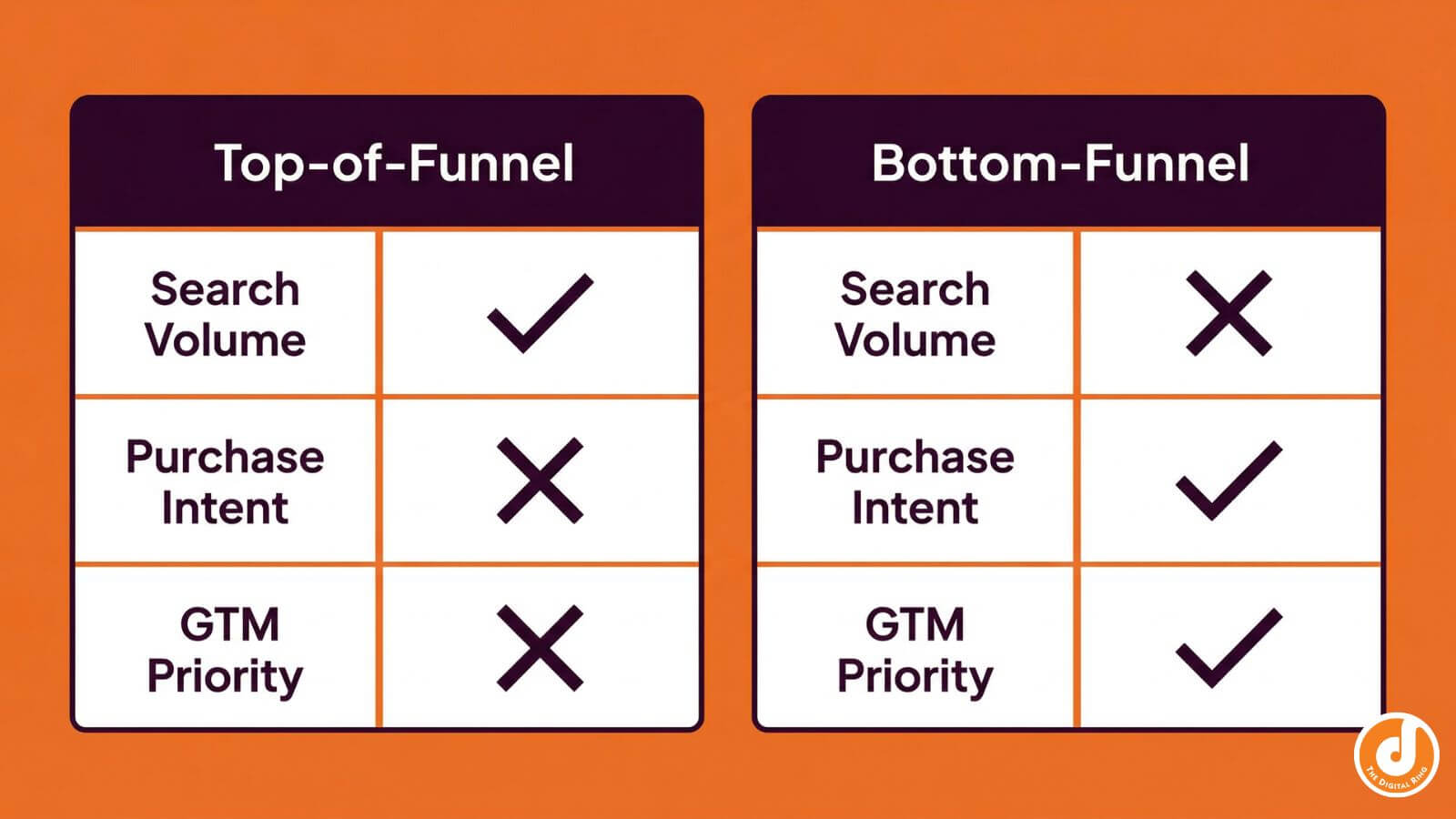
For example:
- "Best project management software for SEO agencies"
- "CRM with multi-client reporting features"
- "Platform comparison: Tool A vs Tool B"
Those queries indicate readiness as they align directly with revenue attribution goals.
Map Content to Buyer Journey Trigger Points
Effective SEO and GTM integration requires mapping content to real trigger points, not abstract funnel stages.
Teams often misapply the statistic that buyers consume three to five pieces of content. They create scattered content across awareness, consideration, and decision without anchoring it to actual search behavior.
Instead, cluster keywords by intent:
- Problem-aware searches: Users recognize an issue but haven't chosen an approach.
- Solution-aware searches: Users evaluate categories of solutions.
- Comparison searches: Users compare vendors or platforms.
- Platform-based searches: Users research specific brands.
Each cluster should contain three to five focused pieces. That volume establishes authority without fragmenting effort.
For example, in a SaaS launch:
- Problem-aware: "How to manage multiple client SEO campaigns efficiently."
- Solution-aware: "Best tools for multi-client SEO management."
- Comparison: "Tool A vs Tool B for agency reporting."
- Platform-based: "YourBrand integrations with Google Analytics.
Ensure every cluster attracts your ideal customer profile. High traffic without qualification increases customer acquisition cost and strains sales teams. Buyer journey mapping becomes actionable when tied to search intent analysis.
Align SEO with GTM Teams Around Shared Metrics
Cross-functional alignment determines whether SEO supports your go-to-market plan or operates in isolation.
According to The Spot, only 27 percent of organizations say their GTM teams are fully integrated across strategy, KPIs, and execution. That gap creates misaligned incentives.
Sales teams provide deal-breaker questions, product teams clarify differentiation and roadmap priorities, and marketing maps content to buyer journey stages.
Alignment across all these steps requires shared metrics. You should track:
- Sustained organic traffic growth from ICP-fit segments
- Time on page for solution-aware content
- CTA engagement rates on high-intent pages
- Conversion rates across funnel stages
- Revenue attribution from organic acquisition
Rankings and impressions are lagging indicators. Traffic patterns and engagement on key pages provide earlier signals of pipeline health.
For example, if solution-aware pages show rising traffic and increasing demo clicks, you're strengthening the relationship between SEO and go-to-market strategy. If traffic grows but conversions stall, revisit product positioning or CTAs.
Sales enablement also benefits. Content addressing integration questions or pricing structures equips reps with pre-qualified prospects. Conversations move faster and pipeline velocity improves.
Turning SEO Into a GTM Multiplier
Aligning SEO strategy with go-to-market plan execution can transform your launch day. Instead of chasing attention, you activate an audience that already exists.
The relationship between SEO and go-to-market strategy is structural. When integrated early, SEO strengthens market entry strategy and supports sustainable demand generation long after launch.
If you're preparing for a major launch or rethinking your market entry approach, our team can help you embed SEO into your GTM from the start. Let's work together to build a launch strategy that compounds before, during, and after day one.
share this article


Get In touch
We’d love to share how digital marketing can help elevate your brand — and your business’s bottom line.


821 E Washington Ave #200
Madison, WI 53703
608.836.7464


