


How to Set Up an Automated Sales Funnel That Feels Human
Automation that converts has one thing in common: it sounds like a person, not a platform.
Most automated marketing funnels break on messaging. 76% of companies see positive ROI from automation within a year, which means the tools are working. What breaks down is the communication inside them — overwritten emails, generic company overviews, stiff follow-up sequences that buyers delete before finishing the first line.
Compare these two follow-ups:
“I wanted to circle back regarding our enterprise-ready solution and see if you had time to review the attached resources.”
vs.
“Quick question: still something you’re exploring?”
One is a monologue. The other is a conversation. How the message treats the reader is what makes the difference.
Sales funnel marketing automation that feels human responds to real buyer behavior the way a skilled rep would: with timing, relevance, and a short ask. When that’s working, buyers engage. When it isn’t, they disappear into your pipeline.
What Is Sales Funnel Marketing Automation?
Sales automation is the use of software to handle repetitive sales tasks, move prospects through your process, and support timely follow-up without requiring a person to manually manage every step.
A sales automation system is the connected setup that makes that possible. It usually includes your CRM, email or sequencing tools, lead data, workflow triggers, and reporting. Together, these pieces help your team understand who a prospect is, what they’ve done, and what should happen next.
In an automated marketing funnel, the goal is to keep communication consistent while still making it feel relevant. That means your system should help with things like:
- Lead capture: Collecting information from forms, ads, landing pages, or outreach
- Lead routing: Sending prospects to the right person or workflow
- Follow-up timing: Drip campaigns and behavioral triggers that send emails, reminders, or tasks based on activity
- Qualification: Identifying which prospects are worth more immediate attention
- Reporting: Showing which parts of the funnel are working and where people drop off
Sounds pretty cool, right? We agree. But you have to be aware of a few common mistakes if you want sales funnel marketing automation to really work for you.
Why Most Automation Fails (And It's Not the Technology)
Before we get into what makes automation work, it helps to look at common communication pitfalls. cause the tech is weak, but because the messaging inside the funnel works against them. The intent is good, but the experience still feels robotic. And when you zoom out, the breakdown usually comes from a few familiar mistakes.
- Too much information, not enough clarity: Overloading sequences with features, value props, and long explanations usually overwhelms buyers instead of persuading them.
- Messages that broadcast instead of connect: Automation often reads like a brochure, polished and one-sided, rather than creating a genuine conversation with the prospect.
- Emails that feel scripted instead of human: Long, over-produced emails with multiple selling points tend to feel robotic, while shorter, more natural messages with one clear next step convert better.
- Sequences that ignore context and behavior: Automation breaks down when it fails to adapt to engagement signals, like continuing follow-ups after someone already booked a meeting. For example, someone who downloaded a pricing guide and revisited your site three times likely needs a different follow-up than someone who never opened the first email.
- A lack of emotional intelligence: Buyers notice tone immediately, and automation that never adjusts timing, pacing, or communication style feels flat and mechanical.
If these pitfalls are the problem, the good news is that there are clear practices that consistently turn automated funnels into systems that feel human, helpful, and genuinely effective. Here’s what those look like.
Write Like a Human, Not a Sales Pitch
Most sales automation fails because it imitates the habits of bad sellers. Long intros, dense value props, overly formal phrasing. These are the things that make automation sound stiff and robotic. In contrast, the best communicators keep things simple:
- They ask one question at a time.
- They shift based on how the other person responds.
- They know when to add personality and when to stay direct.
- They choose clarity over cleverness.

Automation can mirror those same instincts when it’s built with intention. Short messages with natural phrasing (“quick question”) feel far more human than formal openers like “I hope this message finds you well.” A simple acknowledgement (“I know this is automated, so I’ll keep it short”) creates honesty instead of pretending a script is spontaneous.
Buyers need communication that respects their time. Whether a human typed every message matters far less than whether it felt worth reading. When harnessed correctly, AI can remove the monotony from selling, giving humans more space for the real conversations buyers care about. When automation clears the noise, your team can focus on what they do best.
Let Buyer Signals Drive What Happens Next
Engagement is a conversation, even when no one replies. Silence tells you something. High engagement tells you something else. And both signals should change what your automation does next.
No Response Is Still a Signal: Change Channels
If someone hasn’t opened or clicked in a while, your outreach should change channels or tone. A thoughtful progression might move from email to text to phone to a simple calendar prompt. Each touch should reference the previous one and make opting out easy. For instance, if a prospect ignores three emails in a row, your system might stop sending case studies and instead trigger a short, “Totally fine if timing’s off. Should I close the loop for now?” response.
High Engagement Means Step Back and Let a Human In
If someone is opening every message, clicking multiple links, revisiting your site, or viewing your profile, the automation should slow down and make room for a human to step in. Adding pressure at this stage works against you.
Small Actions Reveal Big Intent
Behavior such as repeat visits, content downloads, logins, or support searches all reveal intent. Meeting bookings are the strongest signal of all. Once someone books time, your automation should instantly shift from prospecting to preparation and relationship-building.
Track One Metric Per Funnel Stage, Then Improve
Every stage of your funnel has one metric that matters most. Focusing on one clear outcome per stage leads to more predictable improvements and supports conversion rate optimization across the funnel.
- Top-of-funnel deliverability: Clean, accurate prospect data protects your sender reputation and improves the likelihood that emails actually land in inboxes.
- First-touch open rates: Subject lines determine whether your outreach gets seen at all, making A/B testing and refinement critical at this stage.
- Initial engagement and response rates: Short, conversational messages with a clear purpose consistently outperform long or overly polished outreach.
- Qualification and meeting success: Lead scoring helps surface marketing qualified leads (MQLs) earlier so teams spend more time in productive conversations.
- Bottom-of-funnel close rates: Automation supports consistent communication, but conversions still depend heavily on offer strength, pricing, and human selling ability.

Your Systems Need to Talk to Each Other
An automated funnel only works when the right systems can share information. If your CRM, outreach tools, and reporting platforms all operate separately, your team ends up filling the gaps manually. CRM integration is usually the first piece to align. That’s where automation starts to feel clunky without it.
The main systems include:
- CRM: Platforms like HubSpot or Salesforce store contact records, pipeline management data, lifecycle stages, and deal information. This should be the source of truth for your sales and marketing teams.
- Sequencing tools: Tools like Outreach, Salesloft, Lemlist, or Instantly help manage email sequences, follow-ups, and prospect touchpoints.
- Data enrichment tools: Platforms like Apollo, ZoomInfo, or Clearbit (now integrated with HubSpot) help fill in missing company, contact, and firmographic details so your team can qualify and segment leads more accurately.
- Integrations: Native integrations, Zapier, Make, or custom API connections help move information between systems so actions in one platform can trigger the right next step somewhere else, including retargeting workflows across channels.
- Reporting tools: HubSpot reporting, Salesforce dashboards, GA4, and CallRail can help connect activity to funnel performance, especially when your team needs visibility into lead sources, conversions, and revenue attribution.
The specific tools matter less than how well they work together. HubSpot may be the right fit for a team that wants CRM (learn more about that here), email, automation, and reporting in one system. Salesforce may make sense for larger or more complex sales organizations. Apollo or Outreach may be valuable if outbound prospecting is a major part of your funnel.
Either way, the point is to choose tools based on how your team actually sells, follows up, and measures success. That decision is the foundation of effective marketing operations.
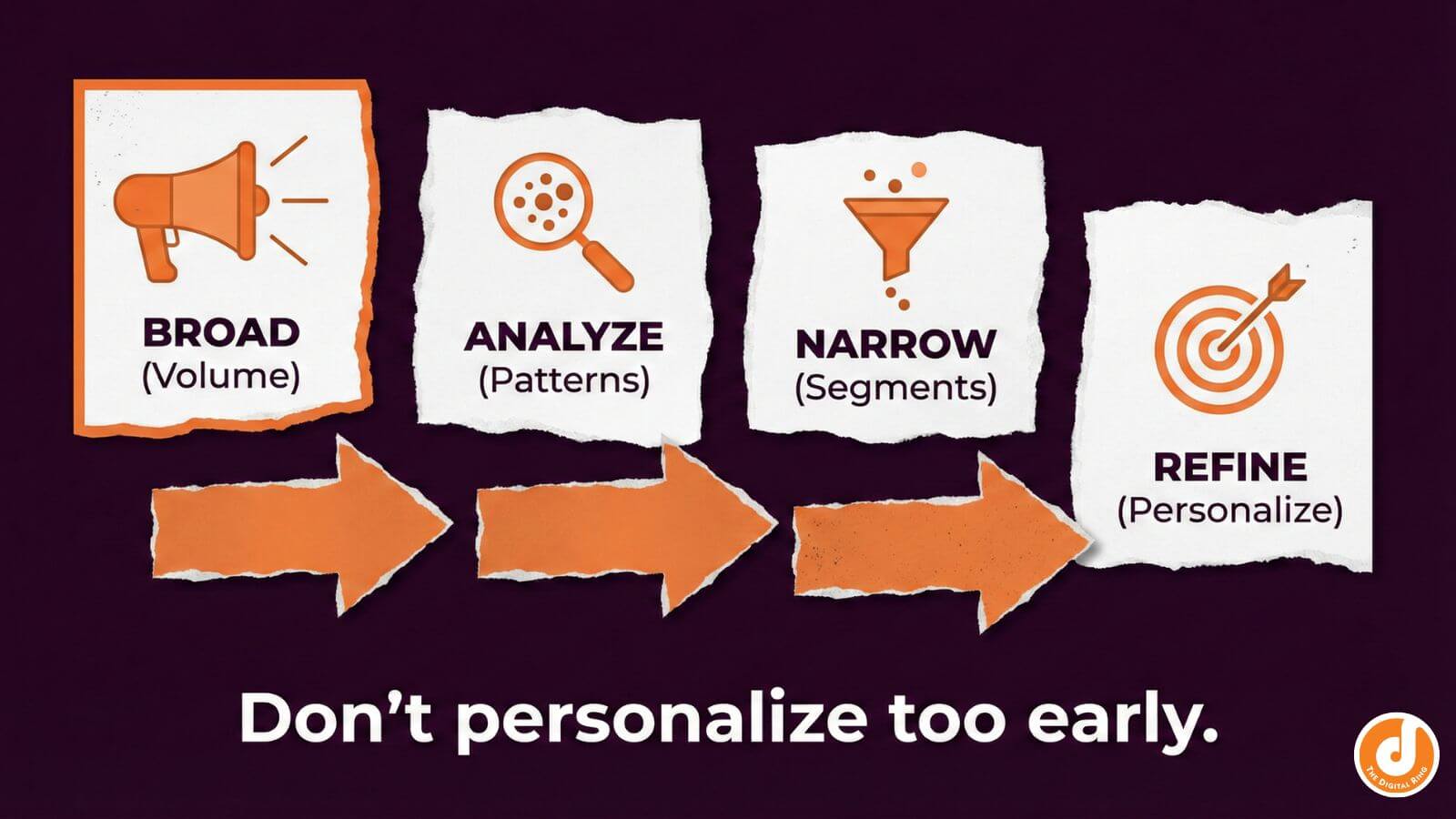
Automate Your Volume First, Then Personalize
Most marketers personalize too early. It feels strategic, but it slows learning. Broad outreach at the top of the funnel allows you to collect real behavioral data, test messaging at scale, and identify the right audience segmentation before narrowing in.
Volume is your strongest revenue lever. Once you understand what works, personalization at scale becomes significantly more effective because it is based on real patterns rather than assumptions.
The right sequence is always: broad → analyze → narrow → refine.
Say you send the same top-level message to 500 operations leaders and notice manufacturing companies reply twice as often as SaaS companies. That insight gives you a real segment to personalize around instead of guessing upfront.
Teams that skip straight to the “refine” step miss out on stuff like this, and therefore end up optimizing based on guesswork alone. And because 35-50% of sales go to the business that responds first, automation’s ability to create instant engagement matters more than hyper-specific personalization early in the process.
Pick Software That Solves One Problem First
A funnel that feels human only works if your software supports the way you want to communicate. The right sales automation tool should make things easier, not more complicated. Here’s how to pick software that actually improves your process.
Start with one problem you want to fix
Don’t choose a platform just because it has a long list of features. Start by finding the one part of your funnel that slows you down or loses the most leads. Pick software that helps you fix that specific issue first. It keeps the project focused and the results easy to measure.
Choose tools that react to what people do
Look for software that changes its messages based on how someone interacts: whether they opened an email, clicked a link, replied, visited your website, or booked a meeting. Tools that adjust based on real behavior always feel more natural than ones that push everyone through the same steps.
Create flexible message paths, not one big blast
Good automation feels personal because it pays attention. It references what someone has already done, changes tone when engagement shifts, and knows when to pause. Build message paths that adjust along the way instead of sending the same message to everyone.
Roll it out slowly across the team
Once you’ve improved one part of the funnel, bring the same approach to other teams.
- Marketing gets cleaner data.
- Support gets helpful reminders and follow-ups.
- Customer success gets easier renewal and engagement tools.
Each small improvement gives time back to the team.
Measure more than revenue
Judge success by time saved, cleaner data, happier teams, and customers who stick around longer. These wins matter just as much as closed deals.
Post-Sales Is Where Loyalty and Expansion Are Won
Post-sales is often the quietest part of the funnel, even though it’s the stage where lifecycle marketing, loyalty, advocacy, and expansion take shape. Many companies shift buyers into generic marketing emails after the deal closes, which creates a sharp drop-off in the customer experience.
Post-sales automation should feel even more human, not less. Helpful usage tips, quick check-ins, milestone recognition, success stories, and renewal guidance all reinforce value. And just like in pre-sales, behavior should drive the next touch.
Signals such as logins, dips in usage, support tickets, feature adoption, and renewal timelines can all trigger intelligent, personalized outreach. These moments help customers feel supported, which increases NPS and encourages referrals far more effectively than a one-size-fits-all campaign.
When your automation continues after the sale with the same tone and thoughtfulness it had before the sale, customers stay engaged, loyal, and willing to advocate for your brand.
Build One Clean Workflow First, Then Expand
Once you understand what your funnel needs and which tools can support it, start small. Focus on building one clean, useful workflow your team can trust.
A simple setup process might look like this:
- Map the current funnel: Identify how leads come in, who handles them, what follow-up happens, and where prospects tend to drop off.
- Choose one bottleneck to fix first: Start with a clear issue, such as slow follow-up, poor lead routing, inconsistent lead nurturing, or stale pipeline. If leads regularly sit untouched for two or three days after form submissions, that’s a strong first automation opportunity. A simple workflow assigning leads instantly and triggering a same-day follow-up can dramatically improve response speed.
- Clean your data: Make sure contact fields, lead sources, lifecycle stages, and ownership rules are accurate enough to trigger automation reliably.
- Build one workflow: Create a focused automation that solves the chosen bottleneck, such as assigning new leads, sending a short follow-up sequence, or notifying sales when a prospect takes a high-intent action.
- Test before launch: Run sample contacts through the workflow to check timing, messaging, routing, and suppression rules.
- Monitor and adjust: Review engagement, reply rates, meeting success, and conversion quality. Then refine the workflow before expanding to the next use case.
This is how sales funnel marketing automation becomes manageable. You build confidence one workflow at a time, then expand once you’ve got buy-in.
What a Human-First Funnel Gives Your Team
When your funnel behaves like a skilled communicator, it functions as a valuable extension of your team.
Prospects get messages that feel natural, signals become easier for your reps to interpret, and your team spends more time on the conversations that actually move deals forward. This results in a customer journey that feels more intentional, personal, and respectful of attention.
A sales funnel that feels human is completely achievable when you build it with emotional intelligence at the center.
If you’re looking for guidance as you put these ideas into practice, we want to help. We offer resources and support to help teams build clearer messaging, stronger funnels, and more meaningful buyer experiences.
share this article
.jpg)

Get In touch
We’d love to share how digital marketing can help elevate your brand — and your business’s bottom line.


821 E Washington Ave #200
Madison, WI 53703
608.836.7464


