


What Is AI SEO, GEO, & AEO? Staying Visible in AI Search
For years, SEO has been about visibility: rank high, earn clicks, repeat. But now, the game has changed. AI has rewritten the rules of how people find information, and that shift is rippling through everything we know about organic search.
Google’s Search Generative Experience (SGE). ChatGPT’s search mode. Perplexity AI’s conversational summaries. They’re all part of a new ecosystem where answers come before links, and where brands must adapt to stay seen, cited, and trusted.
That’s where AI SEO (sometimes called AEO, or GEO) comes in. It’s not about chasing rankings. It’s about positioning your brand as a source that AI systems trust enough to include in their answers.
Let’s break down what that means, why it matters, and how to stay visible when search gets smarter.
The Rise of AI Search: From Links to Answers
Traditional search worked like a librarian. You asked a question, and it handed you a list of books (links) to explore.
AI-driven search, on the other hand, acts like a researcher. It doesn’t point you to answers; it creates them.
Tools like ChatGPT and Perplexity scour the web, summarize key takeaways, and present synthesized responses, often without users ever leaving the interface. Google's AI Overviews do the same thing, blending organic results with AI-written snippets.
That means:
- Fewer clicks to websites.
- More zero-click experiences.
- Higher stakes for content quality and authority.
If your content isn't being referenced, it's effectively invisible, no matter how high you rank on traditional SERPs.
Jono Alderson, independent technical SEO consultant, explains: "This 20-year period we've had of typing into an input box and getting a list of links was a temporary dysfunction on that journey." This shift represents a fundamental evolution in how users access information - from navigating lists to receiving direct, synthesized answers.
AI SEO ensures your brand becomes part of those synthesized answers. The goal isn't to chase keywords; it's to build structured, trustworthy content that language models view as reliable.
AEO, GEO, AI SEO: What’s the Difference?
You’ll see different acronyms floating around, but here’s what they boil down to:
- AI SEO (Artificial Intelligence Search Engine Optimization): The umbrella term for optimizing content so AI search systems can easily discover, interpret, and summarize it accurately.
- AEO (Answer Engine Optimization): Focused on earning citations within AI-generated answers in platforms like ChatGPT or Perplexity.
- GEO (Generative Engine Optimization): The research term used in academia to describe how generative models decide which content to surface or cite.
Different names, same north star: helping your brand get discovered, understood, and included in AI-driven search results.
Why AI SEO Matters for Marketers
Let’s be clear: this isn’t just a technical evolution, it’s a marketing one.
When search shifts from listings to answers, your brand visibility depends less on where you rank and more on what you contribute.
In AI-generated results, visibility doesn’t come from being #1; it comes from being trusted enough to quote.
That changes your content priorities:
- Depth over frequency: A handful of authoritative, evergreen pages beats a hundred shallow blog posts.
- Precision over persuasion: AI looks for clarity and confidence, not marketing fluff.
- Structure over storytelling: Headers, lists, schema markup, and FAQ formatting give AI clear signals about what's where.
In other words, your content isn't just competing for clicks anymore. It's competing for inclusion in the world's smartest algorithms. Research from Stanford University's Human-Centered AI Institute shows that 71% of organizations now use generative AI in at least one business function, more than double the 33% reported in 2023, demonstrating how rapidly AI systems have become integral to information discovery.
How AI Changes the Search Game
Here’s what’s really happening behind the scenes: AI models like GPT-4 and Gemini read your content not as human prose, but as structured information. They use cues like entities, relationships, and topical authority to decide whether your page is relevant enough to reference.
That means the classic SEO formula (keywords + backlinks + freshness) still matters, but it’s only the foundation.

The New Signals AI Pays Attention To
- Clarity and authority: AI prefers content written like an expert talking to peers, not a brand pitching to buyers. It looks for unambiguous language, clear takeaways, and consistent topical relevance.
- Semantic structure: Generative engines love context. Proper use of H1–H3 headings, schema markup, and internal linking helps them understand how ideas connect.
- Citations and credibility: If trusted domains reference you, or if you consistently produce primary research, you’re more likely to be pulled into AI-generated answers.
- Formatting and accessibility: Structured elements like FAQs, tables, and step-by-step breakdowns help AI parse your content faster and summarize it accurately.
In short: the more machine-readable your expertise is, the more likely it becomes part of AI search results.
From Rankings to Citations: The New SEO KPI
Here’s the mindset shift: Traditional SEO chases rankings. AI SEO chases citations.
Your goal is no longer to appear in a list. It’s to appear in the conversation.
Imagine your content as source material for an AI researcher. You want your site to be the expert it quotes when answering user questions.
That means:
- Leading with strong, evidence-backed claims.
- Using plain, confident language that can be easily excerpted.
- Including data, examples, or definitions that simplify complex concepts.
For example, if you publish a piece on “how AI SEO works,” you don’t just want to describe trends. You want to define the term, explain its mechanics, and illustrate real-world implications. Those details make your content “citation-ready.”
Brand Mentions Are the New Backlinks
Backlinks still matter, but AI search has expanded the definition of authority.
Generative engines can recognize brand mentions even when they aren’t hyperlinked. That means if credible sites mention your company name or cite your research, AI connects the dots.
For marketing teams, this opens new doors:
- Earned media and PR: Getting quoted in reputable publications now directly fuels AI visibility.
- Thought leadership: Sharing unique insights on platforms like LinkedIn or industry blogs reinforces your authority in the AI ecosystem.
- Unlinked mentions tracking: Tools like Ahrefs or Brand24 can help you find and capitalize on those references.
In AI SEO, every credible mention strengthens your signal, even without the traditional blue link.
How to Optimize for AI Search (Without Losing Your Mind)
Let’s get practical. You don’t need to overhaul your entire SEO strategy overnight. Start by reinforcing what already works, then layer on AI-specific optimization.
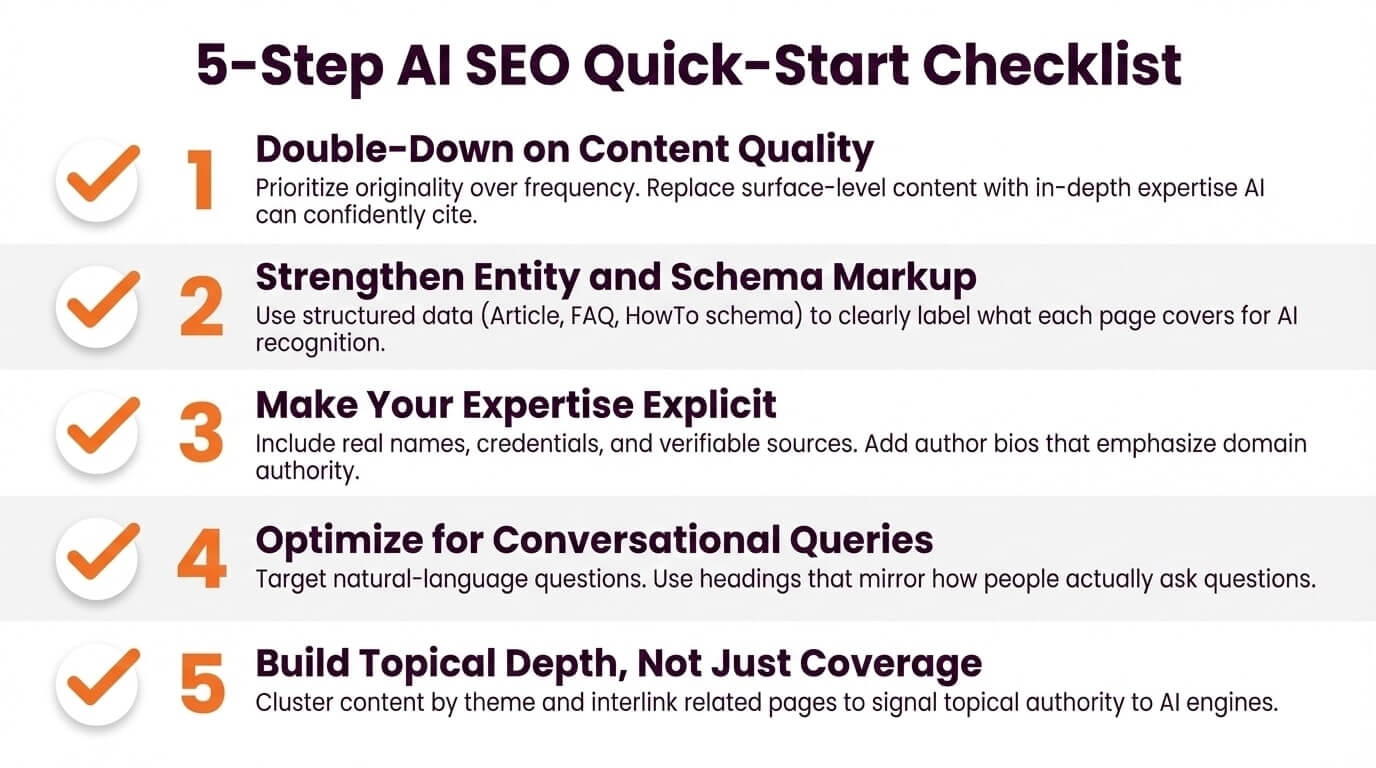
1. Double-Down on Content Quality
AI doesn’t reward frequency; it rewards originality.
Audit your content library and ask:
- Does this page offer a unique perspective or just rephrase what’s already ranking?
- Would an AI model quote this paragraph as an example of expertise or ignore it as filler?
Replace surface-level listicles with in-depth explainers, frameworks, and case studies. When in doubt, think “What could ChatGPT confidently pull from this?”
2. Strengthen Entity and Schema Markup
Structured data isn't optional anymore. Research from Schema.org and Google's structured data guidelines demonstrate that proper schema markup (like Article, FAQ, or HowTo) significantly improves AI interpretation accuracy.
Example: A blog titled “AI SEO Checklist” can use schema to highlight actionable steps. That helps AI engines recognize list items as answers, not just formatting.
3. Make Your Expertise Explicit
Use real names, credentials, and sources. Include author bios that emphasize domain authority. The more verifiable your expertise, the more trustworthy your site becomes to AI models.
Example: Instead of “Our team helps brands grow online,” use “Written by Joe Schmo, SEO strategist with 10+ years in digital growth.”
4. Optimize for Conversational Queries
AI search mirrors how people ask questions, not how they type them into Google. That means targeting natural-language queries:
- “How does AI SEO work?”
- “What’s the difference between AEO and GEO?”
- “How can I get my content featured in AI summaries?”
Use headings and phrasing that mirror those conversations.
5. Build Topical Depth, Not Just Coverage
AI engines prefer experts over generalists. Cluster your content by theme (e.g., SEO fundamentals, analytics, AI trends) and interlink related pages. That signals authority around a topic, not just a keyword.
Example: AI SEO in Action
Let’s say you manage digital strategy for an insurance company. You publish a guide titled “How AI Is Changing Risk Assessment in Insurance.”
Old SEO logic: Optimize for the keyword, build backlinks, and track rankings in Google.
New AI SEO logic: Structure it like a resource that an AI system could confidently cite when explaining the future of insurance or underwriting.
That means including:
- Definitions: “AI-driven risk assessment refers to using machine learning algorithms to analyze patterns in claims and predict potential losses.
- Use cases: “For instance, some insurers are already using generative AI to assess nontraditional risk factors, such as satellite imagery or telematics data.”
- Credible sources: “According to a 2024 Deloitte report on AI adoption in insurance…”
The result? When someone asks Perplexity, “How is AI being used in insurance risk modeling?” your page becomes one of the sources it references.
The Future of AI SEO: Preparing for What’s Next
We’re only at the beginning. Over the next 12–18 months, expect:
- More personalization: AI search results will adapt to user intent and history, emphasizing brand familiarity.
- Dynamic citations: Content that stays updated will be favored over static pages.
- Integrated ecosystems: Expect partnerships between AI platforms and publishers, where verified data feeds models directly.
That means SEO and PR will blur even further. Visibility won’t just be about keywords, it’ll be about credibility streams that flow through multiple digital channels.
Key Takeaways
- AI didn’t kill SEO, it matured it. Search is evolving from a list of links into a layer of intelligent, synthesized information.
- Authority is the new currency. Structured, expert-driven, and verifiable content wins.
- Your visibility now depends on clarity, not cleverness. The easier it is for AI to understand you, the more likely you’ll be cited.
- very credible mention counts. Brand awareness, PR, and thought leadership all feed your AI SEO footprint.
Final Thought: Visibility Now Belongs to the Clear and the Credible
In the age of AI search, you can’t just chase clicks. You have to earn citations.
That means thinking less like a marketer and more like a teacher. Document your expertise. Structure your insights. Make your answers undeniable.
Because when the next generation of search engines looks for the smartest sources on the web the question isn’t “Who ranks first?” It’s “Who do we trust enough to quote?”
If you’re not sure where to start, or how to adapt your SEO strategy to this new AI-driven world, we can help. Our team helps brands clarify their expertise, strengthen their content signals, and build the kind of authority AI can’t ignore.
Let’s make sure when the answers are written, your brand is part of them.
share this article

Get In touch
We’d love to share how digital marketing can help elevate your brand — and your business’s bottom line.


821 E Washington Ave #200
Madison, WI 53703
608.836.7464


